
CASH FLOW CALCULATOR
13-Week Cash Flow Calculator
See your bank balance for each of the next 13 weeks, with wages, super, BAS and PAYG placed in the weeks they’re actually paid. Find the tightest week while there’s still time to plan for it.
- Closing balance every week, and the lowest point
- BAS, PAYG and Payday Super on their due dates
- Shortfall against your minimum, and runway
For Australian businesses with staff and GST. Results show as you type. No sign-up.
From Acctivate Business Accountants, led by Chartered Accountants Elle Green and Simon Burke. Registered Tax Agent.
13-week cash flow forecast: enter your figures
Enter amounts as they reach or leave the bank, including GST. The forecast updates as you type.
Your forecast
Add your opening balance and typical weekly receipts to see your forecast.
Lowest balance
–
Balance at the end of week 13
–
Runway
–
Based on the average weekly change across the 13 weeks.
- Money in–
- Money out–
- Net change–
Over the 13 weeks.
Paid in these 13 weeks
- BAS and tax–
- Super–
- Net wages–
Tax and super built up, due after week 13
–
GST, withholding and super from these weeks that falls due later. It isn't spare cash.
Not included: overdraft limits, income tax beyond PAYG instalments, payroll tax, workers' compensation and public holidays. Due dates are the ATO's standard dates; online or agent lodgment can give extra time.
Closing balance by week
Each bar is the balance at the end of the week. The dashed line is your minimum.
Tax payments in these 13 weeks
| Payment | Period | Due | Week | Amount |
|---|---|---|---|---|
| – | ||||
Week by week
| Week | Starts | Money in | Net wages | Super | Suppliers and operating | Rent | Loans | BAS and tax | One-off payments | Money out | Closing balance |
|---|---|---|---|---|---|---|---|---|---|---|---|
| 1 | – | – | – | – | – | – | – | – | – | – | – |
| 2 | – | – | – | – | – | – | – | – | – | – | – |
| 3 | – | – | – | – | – | – | – | – | – | – | – |
| 4 | – | – | – | – | – | – | – | – | – | – | – |
| 5 | – | – | – | – | – | – | – | – | – | – | – |
| 6 | – | – | – | – | – | – | – | – | – | – | – |
| 7 | – | – | – | – | – | – | – | – | – | – | – |
| 8 | – | – | – | – | – | – | – | – | – | – | – |
| 9 | – | – | – | – | – | – | – | – | – | – | – |
| 10 | – | – | – | – | – | – | – | – | – | – | – |
| 11 | – | – | – | – | – | – | – | – | – | – | – |
| 12 | – | – | – | – | – | – | – | – | – | – | – |
| 13 | – | – | – | – | – | – | – | – | – | – | – |
Discuss your figures
Your forecast is above. Want an accountant to look over it with you? It’s optional.
We use your details only to respond. Nothing is stored unless you send it. Privacy policy
How to read your cash flow forecast
Lowest balance and the shortfall flag
The lowest closing balance is the week to plan around. If it sits below your minimum, the flag shows how much extra cash would keep every week above it.
Runway
How long the cash lasts if the average weekly change across the 13 weeks continues. If the balance goes below zero inside the 13 weeks, the forecast shows that week instead.
Tax and super built up
GST, withholding and super from these 13 weeks that fall due later. The money is in the bank at week 13 but is already owed.
How BAS lands in the forecast
The calculator estimates GST from your receipts and payments, adds PAYG withheld from each pay run and your PAYG instalment, and places each amount on its standard ATO due date. A weekend due date moves to the Monday.
GST is estimated on a cash basis: one-eleventh of GST-inclusive receipts less one-eleventh of GST-inclusive payments. One-off amounts and loan repayments are left out of the estimate. A week belongs to the BAS period its first day falls in.
Where each figure comes from
| Figure | What it means | Where to find it |
|---|---|---|
| Opening balance | Cash across your operating accounts today | Bank feeds or statements |
| Weekly receipts | What customers pay in a typical week | Sales history, unpaid invoices and when customers actually pay |
| Wages, PAYG withheld, super | Each pay run’s gross pay, tax withheld and super | Payroll pay run summary |
| Suppliers, operating costs, rent | Regular bills, including GST | Unpaid bills, lease, recurring payments |
| Loan repayments | Principal and interest | Loan and finance statements |
| BAS owing and GST so far | Tax already owed or building up | Last BAS, ATO online services, GST report in your accounting software |
| PAYG instalment | Quarterly prepayment of income tax | ATO instalment notice or activity statement |
BAS due dates are on each activity statement. If your BAS is lodged online or through a registered tax or BAS agent, you may have extra time, except for the October to December quarter.
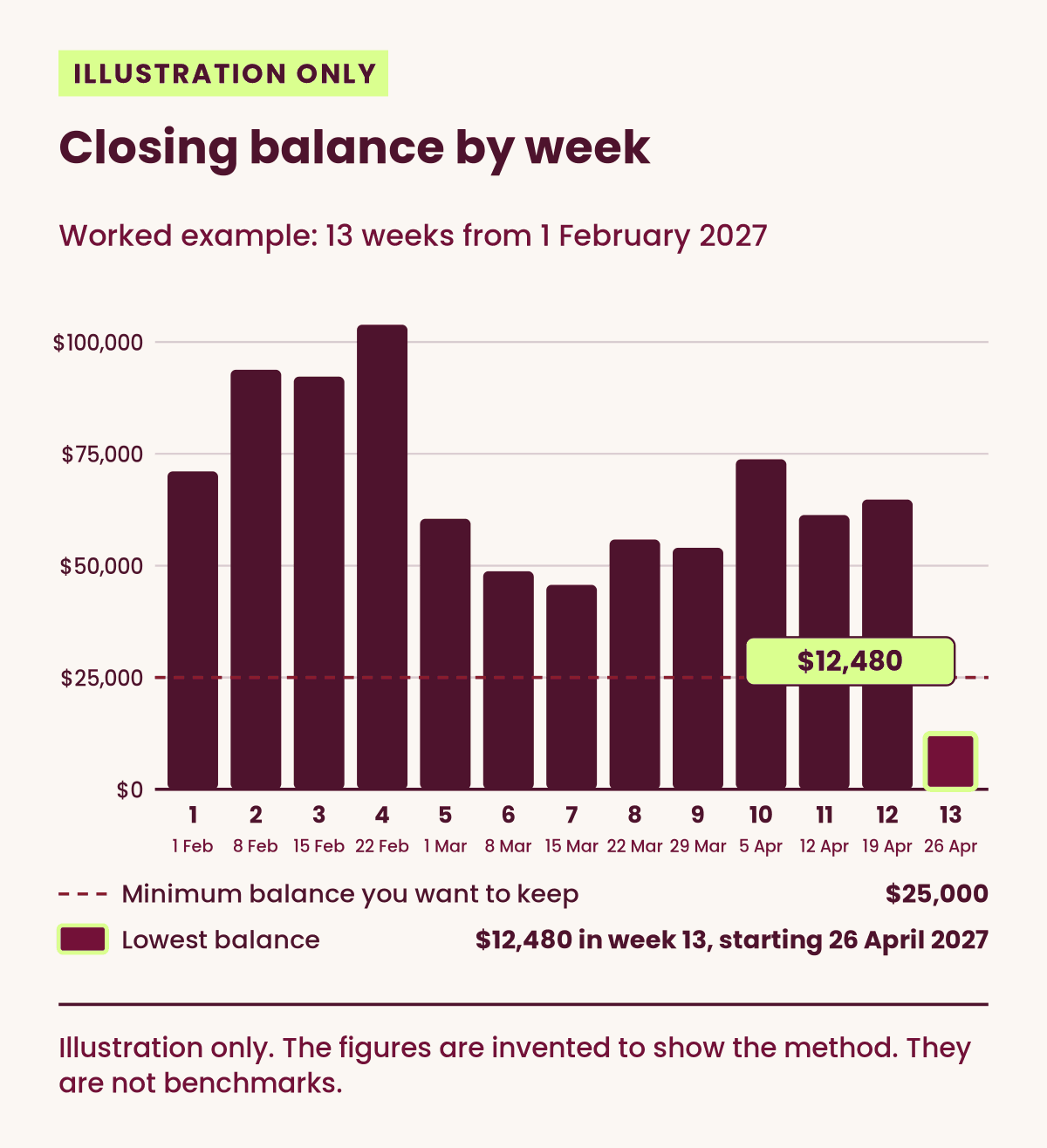
Worked example: 13 weeks from 1 February 2027
Illustration only. The figures are invented to show the method. They are not benchmarks.
A business starts with $85,000 and wants to keep $25,000. Customers pay $44,000 a week including GST, easing 10% by week 13, plus a $15,000 one-off in week 9. Fortnightly pay is $26,000 gross with $5,200 withheld, and super goes out the same week. Suppliers and running costs are $20,900 a week, rent $9,900 a month and a loan $3,200 a month. A $33,000 stock deposit falls in week 6 and an $8,000 premium in week 11. GST is quarterly, withholding monthly, the December quarter BAS of $28,000 is still to pay, and the PAYG instalment is $7,500 a quarter.
| Result | Value |
|---|---|
| Lowest balance | $12,480 in week 13, starting 26 April 2027 |
| Below the minimum | 1 week; extra cash needed $12,520 |
| Runway | About 15.2 weeks |
| BAS and tax paid in the 13 weeks | $98,380 |
| Super paid | $21,840 |
| Tax and super due after week 13 | $17,350 |
| Payment | Due | Week | Amount |
|---|---|---|---|
| PAYG withholding, January | Monday 22 February (21st is a Sunday) | 4 | $10,400 |
| BAS, October to December quarter | Monday 1 March (28 February is a Sunday) | 5 | $28,000 |
| PAYG withholding, February | Monday 22 March | 8 | $10,400 |
| PAYG withholding, March | Wednesday 21 April | 12 | $15,600 |
| BAS and PAYG instalment, January to March quarter | Wednesday 28 April | 13 | $33,980 |
- Weeks 2 to 4 sit above $90,000. The tightest week is week 13, when a pay run, rent, the loan and the March quarter BAS fall together.
- $17,350 of GST, withholding and super has built up by week 13 but isn’t due until May and July.
13-week cash flow questions
Why forecast 13 weeks?
Thirteen weeks is one quarter, so it takes in a full BAS cycle along with every pay run, rent payment and loan repayment in between. It’s near enough to forecast from real invoices and bills, and far enough to see a tight week coming.
When is my BAS due?
Monthly BAS is due on the 21st of the following month. Quarterly BAS is due on 28 October, 28 February, 28 April and 28 July. A due date on a weekend or public holiday moves to the next business day. Lodging online or through a registered agent may give extra time, except for the October to December quarter.
How does Payday Super change cash flow?
For wages paid from 1 July 2026, super guarantee must reach the employee’s fund within 7 business days of payday, and the ATO calls paying on payday best practice. Super now leaves with every pay run instead of building up for a quarterly payment.
How does the calculator estimate GST?
On a cash basis: one-eleventh of your GST-inclusive receipts, less one-eleventh of your GST-inclusive payments, reported in the period the money moves. Businesses with aggregated turnover under $10 million can choose the cash or non-cash basis. On a non-cash basis, GST follows invoices, so the estimate is a guide only.
Do I pay PAYG withholding monthly or quarterly?
It depends on how much you withhold in a year. Small withholders, at $25,000 or less, pay quarterly. Medium withholders, from $25,001 to $1 million, pay monthly. The amount withheld from each pay run is the ATO’s money until it’s paid.
Does the calculator keep my figures?
No. Your figures stay in your browser. They reach Acctivate only if you ask us to look over them.
Cash flow planning with Acctivate
Acctivate works with business owners around Australia from Fortitude Valley, Brisbane, on cash flow forecasting and reporting, BAS and PAYG planning, tax planning and Xero set-up. Chartered Accountants Elle Green and Simon Burke lead the work.
business accounting and advisory
Related services and guides
- Business accounting and advisory
- Tax planning and compliance
- Xero and systems for small businesses
- Accountants for growing businesses
- All business calculators
- Franchise profitability calculator
- Ecommerce product profit calculator
- What a BAS is and how to lodge one
- Seven steps to improve cash flow
- Ecommerce accountants
General information only, not financial, tax or legal advice. The forecast depends on the figures entered, estimates GST on a cash basis and uses the ATO's standard due dates. Your activity statement shows your actual due dates and amounts.
ACCTIVATE PTY LTD · ABN 63 677 493 882 · Level 5/ 269 Wickham St, Fortitude Valley · (07) 3185 5303
