
- CONSTRUCTION AND TRADE ACCOUNTING
Construction Accountants for Builders and Trade Businesses Across Australia
Chartered Accountant-led
Led by Chartered Accountants Elle Green and Simon Burke, the directors and co-founders of Acctivate.
Meet the team
Xero-certified advisers
We set up, review and report from Xero so the numbers you use to run jobs are the numbers in your accounts.
Software support
Registered tax agent services
Tax agent services are provided under the professional obligations of the Tax Agent Services Act.
TASA disclosure statement
5.0 from 200+ Google reviews
Feedback from business owners on advice, responsiveness and follow-through.
Read our Google reviews
Accounting Consultant of the Year 2025
Elle Green was named the winner of Accounting Consultant of the Year at the Women in Finance Awards 2025.
A FULL ORDER BOOK DOES NOT ALWAYS MEAN A HEALTHY BANK BALANCE
Construction accounting services for builders and contractors
Materials and wages are paid before the next claim is approved. A variation adds work weeks before it adds cash. Retentions hold back part of every payment, and several busy sites can still leave the business short at the end of the month. We connect what is happening on site with the numbers you use to run the business: job costs, payment timing, upcoming commitments and tax, read together.
Job costing and margin tracking on every build
Compare the expected margin on each job with what it is actually costing, before the job finishes.
Job profitability
Cash flow between progress claims and retentions
Forecast receipts, retentions, wages, suppliers and tax so the next contract does not run the bank account dry.
Cash flow across jobs
Labour, subcontractor and overhead recovery in quotes
Check that charge-out rates and quotes cover super, leave, supervision, travel and non-billable time.
Labour recovery and overheads
Equipment, plant and vehicle finance decisions
Work out the whole-of-life cost of a machine, truck or ute before you sign the finance.
Equipment and finance
5.0
from 200+ Google reviews
2025
Accounting Consultant of the Year, Elle Green, Women in Finance Awards
CA-led
Chartered Accountants Elle Green and Simon Burke lead every engagement
WHO WE HELP
Accountants for builders, trade businesses and the construction industry
Our work suits established, owner-led businesses with jobs, people and financial commitments to manage. These are the construction and trade businesses we work with most often.
01
Residential builders and home builders
New homes, extensions and residential projects. We look at margins across jobs, the cash needed between stage claims, and the financial tests some states attach to a builder’s licence or registration, such as QBCC’s minimum financial requirements in Queensland, the Building Services Board’s financial requirements in Western Australia and the net assets certificate in the Northern Territory.
Licensing and financial tests
02
Renovation and extension companies
Shorter jobs with more variations, client deposits and administration per dollar of revenue. We help you see which job sizes earn a fair return once the quoting, site visits and paperwork are counted.
03
Commercial builders and fitout contractors
Commercial construction, office and retail fitouts, refurbishment and shopfitting. Subcontractor-heavy delivery means payment schedules, retentions, approved variations and overhead recovery all need to show up in the numbers.
04
Civil, earthworks and roadworks contractors
Excavation, drainage, site preparation, asphalt and road-related work. Plant utilisation, fuel tax credits, crew costs and long claim cycles drive the result. Bitumen Co., an asphalt and civil construction business, is one of our clients.
Equipment and fuel tax credits
05
Electrical contractors
Service work and project work earn different margins, and apprentices, vans and materials change the cost of every hour sold. GQ Electrical is one of the electrical businesses we work with.
Labour recovery
06
Plumbing, drainage and gas businesses
A mix of service, maintenance and project work with a vehicle fleet behind it. We help you test call-out pricing, van costs and whether each type of work pays for the people and vehicles it uses.
07
HVAC, refrigeration and mechanical services
Equipment, parts inventory and maintenance contracts sit alongside installation projects. Reporting by type of work shows whether maintenance agreements and installs each cover their share of overheads.
08
Solar and electrical installation businesses
Supplier deposits, stock, installer crews and warranty call-backs can all land before the customer pays. Sure Solar is one of the solar businesses we work with.
Cash flow across jobs
09
Concreting, formwork and steel fixing
Labour-intensive pours, weather delays and equipment costs make the margin on each job sensitive to time on site. We help you see how delays and rework flow through to the result and to cash.
10
Carpentry, joinery and cabinetmaking
Workshop overheads, materials and quoting accuracy decide whether a busy workshop is a profitable one. We help separate the workshop’s costs from site costs so quotes reflect both.
11
Roofing, painting, tiling and other finishing trades
Roofing, painting, plastering, tiling, glazing and landscaping. High job volume, crew costs and subcontractor reporting make consistent records and TPAR-ready contractor details important.
BAS, GST and TPAR
12
Construction equipment, plant hire and concrete-pumping businesses
Plant, equipment supply and servicing businesses that support construction. Asset finance, imported stock and deferred GST can decide whether growth is affordable, as our published concrete-pumping case shows.
Read the concrete-pumping case
If your business combines several of these activities, we start by understanding where revenue, cost and risk sit across the operation.
Accounting for established construction and trade businesses
We do our best work with construction and trade businesses that want an ongoing accounting and advisory relationship, not a once-a-year lodgement. You are likely to be a good fit if most of these describe you:
- An established, owner-led business in any Australian state or territory
- Annual turnover of $400,000 or more
- A team of employees, regular subcontractors, or both
- More than one job running at the same time
- Equipment, vehicle or finance commitments to manage
- A company, a trust or more than one entity
- Xero in use, or a plan to move to it
- A builder's licence or registration with a financial test, such as QBCC's minimum financial requirements, where you need the regulator's financial reports prepared
- You want someone to explain what the numbers mean and what to do next
When your construction business needs a different specialist
Telling you early saves us both time. Licence financial reporting is not one of these situations: we prepare QBCC MFR reports and the financial reports other state and territory regulators ask for. Our ongoing business service is likely to be more than you need, or the wrong kind of help, in these situations:
- You need only an employee or apprentice tax return. A tax agent who prepares individual returns is the better fit.
- You want a basic once-a-year lodgement with no advice during the year. A compliance-only practice will cost less.
- The business turns over less than $400,000 and the priority is the lowest-cost compliance.
- You need a formal insolvency appointment. That is the role of a registered liquidator or registered trustee.
- You are in a construction dispute, a payment adjudication or need a contract drafted. A construction lawyer handles these.
- You need an independent audit. That requires a registered auditor.
- You need a loan or finance product. A licensed finance broker does this; we can supply the financial statements and forecasts the broker or lender asks for.
- You need a ruling on whether a worker is an employee or a contractor under an award. A workplace-relations adviser handles this; we look at the tax and super consequences.

Published client testimonial
Construction, civil and trade businesses we work with

When to speak to a construction accountant
You do not need to arrive with a neatly defined accounting problem. These are the situations owners most often describe in a first conversation.
| What you are noticing | What needs examining | Where this page covers it |
|---|---|---|
| Revenue is growing but there is little cash left | Payment timing, retentions, job costs, debt, tax and owner drawings | Cash flow across jobs |
| Jobs look profitable until they finish | Remaining costs, labour overruns, rework and unapproved variations | Job profitability |
| You cannot tell which type of work pays best | Consistent job reporting and how shared costs are allocated | Labour recovery and overheads |
| The tax bill is bigger than expected | The year’s forecast position, PAYG instalments and money set aside | Tax planning |
| BAS or super payments are falling behind | Current records, Payday Super deadlines and a realistic payment plan | BAS, GST and TPAR |
| A licence financial report or annual reporting date is coming up | The balance sheet, related-party loans and the regulator’s test | Licensing and financial tests |
| You want to buy a machine or add a crew | The whole cost, the work needed to justify it and the effect on cash | Equipment and finance |
| A bigger contract is on offer | Working capital, overlapping jobs and the claim and payment timetable | Can the business afford the next contract? |
| Your accountant only appears at tax time | Reporting, responsibilities and a review arrangement that suits the business | How the engagement starts |
| You run more than one entity | Related-party balances, shared costs and a combined management view | Structures and several entities |
| There is ATO debt or a customer is paying slowly | What is owed, what can be collected, and what falls due next | Slow payment and tax debt |
Six questions an accountant for your construction business should answer
Annual accounts show whether the business made a profit. They rarely show which jobs produced it, where cash is tied up or whether the business can carry its next commitment. An accountant for a construction business should help you answer these six questions.
Is each build earning its intended margin?
Contract value is not job profit. A useful review compares the margin allowed in the quote with the expected margin at completion, using costs still to come as well as bills already received.
Job costing and WIP
What cash does the next contract need?
A profitable job can still need more cash than the business has during delivery. A forecast shows the weeks of greatest pressure before you sign, not after.
Cash flow forecasting
Are labour and overheads recovered in your quotes?
A charge-out rate must cover more than the hourly wage, and a markup is not the same as a margin. Both mistakes quietly reduce profit on every job.
Labour recovery and markup versus margin
Are you setting aside enough for tax, GST and super?
GST, PAYG withholding, PAYG instalments, super and income tax all fall due on fixed dates, whatever the state of your claims. Knowing the amounts in advance stops them becoming a surprise.
Tax planning
What does that machine really cost to own?
The purchase price is only part of it. Deposit, repayments, insurance, servicing, downtime and the work needed to keep it busy decide whether it pays.
Equipment and finance
Does your business structure still fit how you build?
A structure set up for a sole trader rarely suits a business with crews, plant and several entities. It also affects licence financial tests in some states.
Structures
JOB PROFITABILITY
Construction job costing and work in progress (WIP) reporting
A report showing sales less bills entered so far can make an unfinished job look healthier than it is. The labour still required, committed supplier orders, subcontractor work still to be invoiced, plant hire and approved changes to the contract all affect the final result. We help you check whether your records can answer these questions:
- What did we allow for labour, and what are we actually using?
- Have materials and subcontractor bills been allocated to the right job?
- What costs are committed but not yet invoiced?
- Which variations are approved, and which are still being negotiated?
- What is the expected margin when the job is finished?
The answers show which jobs need attention now and which assumptions in your quotes need changing for the next one.
WIP reporting for unfinished construction jobs
Work in progress, or WIP, accounts for work underway at a reporting date, such as 30 June or the end of a month. It needs support from the contract, progress information and reliable estimates. A signed contract value, a progress claim and the revenue recognised in the accounts are three different measures. We look at how unfinished work is being recorded, what information supports the calculation and whether the result makes sense against the job’s actual progress. This matters most when jobs cross reporting dates or a job is heading for a loss.
Estimated cost to complete versus costs to date
Costs to date tell you what has been spent. Estimated cost to complete tells you what the job will finally earn. Comparing the two with percentage complete shows whether a job is tracking to its margin or using up its budget faster than the work is progressing. A job that is 50% complete but has used 70% of its cost budget needs a conversation now, while there is still time to recover a variation, change the crew or adjust the next claim.
Worked example: a construction job margin after cost overruns
Illustration only. All figures exclude GST. This is an estimated completed-job margin, not revenue recognised in financial statements.
| Item | Original estimate | Updated forecast |
|---|---|---|
| Contract revenue, including approved variations | $500,000 | $520,000 |
| Total direct job costs, including costs still to complete | $380,000 | $420,000 |
| Contribution before business overheads, finance and tax | $120,000 | $100,000 |
| Contribution as a percentage of revenue | 24.0% | 19.2% |
- The extra $20,000 of approved revenue is outweighed by an extra $40,000 of expected costs. The job still contributes, but $20,000 less than planned.
- Whether the job earns enough overall also depends on overheads, finance and other business costs, which this table does not include.
- A useful review asks why the cost forecast changed, what can still be controlled and what the next quote should allow for. Looking only at invoices already received would miss most of that.
Charge-out rates, labour recovery and overheads for builders
A charge-out rate has to cover more than the employee’s hourly wage. Superannuation guarantee at 12% of qualifying earnings, leave, insurance, supervision, travel between sites and non-billable time all add to the cost of each hour sold. The office also needs funding: rent, software, vehicles not on a job, estimating time and management.
We help you separate the direct contribution from each job from the profit left across the whole business, and recover overheads in a way that reflects how each type of work uses them. A service call, a fitout and a civil job do not use the office, the yard or the owner’s time in the same way, so one overhead percentage applied to every job can overprice some work and underprice the rest.
Markup versus margin when pricing construction jobs
Markup is calculated on cost. Margin is calculated on the selling price. A 25% markup on $100 of cost gives a $125 price and a $25 contribution, which is a 20% margin, not 25%. If your target is a 25% margin, the price on $100 of cost has to be about $133.33. The gap matters when you price a job on markup and then judge the result on margin.
| Measure | How it is calculated | Example on $100 of cost |
|---|---|---|
| Markup | Profit ÷ cost | $25 ÷ $100 = 25% |
| Margin | Profit ÷ selling price | $25 ÷ $125 = 20% |
| Price for a target margin | Cost ÷ (1 − target margin) | $100 ÷ (1 − 0.25) = $133.33 |
Illustration only. Figures exclude GST.
Security of payment, progress claims and retentions by state
Every state and territory has a security of payment law that sets when a progress payment falls due and how long the other party has to dispute a claim. Those dates decide when cash should arrive, so they belong in your cash flow forecast and your debtor reporting. The table summarises the timeframes where the contract is silent or sets a longer period. “Business days” means business days as each Act defines them. Always check your contract, because many contracts set an earlier date.
| State or territory | Act | When a progress payment is due | Payment schedule if not paying in full |
|---|---|---|---|
| Queensland | Building Industry Fairness (Security of Payment) Act 2017 | On the date in the contract, otherwise 10 business days after the claim. For subcontracts, no later than 25 business days | Within 15 business days |
| New South Wales | Building and Construction Industry Security of Payment Act 1999 | Where the contract is silent: 15 business days (head contractor claiming from the principal), 20 business days (subcontractor, non-residential work), 10 business days (exempt residential work) | Within 10 business days, or the full claim becomes payable |
| Victoria | Building and Construction Industry Security of Payment Act 2002, as amended from 15 April 2026 | No later than 20 business days after the claim, whatever the contract says; 10 business days if the contract sets no date | Within 10 business days, or sooner if the contract says so |
| Western Australia | Building and Construction Industry (Security of Payment) Act 2021 | 20 business days (head contractor claiming from the principal), 25 business days (subcontractor), or earlier if the contract says so. Home building: the contract date, otherwise 10 business days | Within 15 business days, or the contract’s shorter period |
| South Australia | Building and Construction Industry Security of Payment Act 2009 | On the date in the contract, otherwise 15 business days after the claim | Within 15 business days, or the contract’s shorter period |
| Tasmania | Building and Construction Industry Security of Payment Act 2009 | On the date in the contract, otherwise 10 business days, or 20 business days if the respondent is a residential home owner | Within 10 business days, or 20 business days for a residential home owner |
| Australian Capital Territory | Building and Construction Industry (Security of Payment) Act 2009, as amended from 11 March 2024 | The earlier of 15 business days after the claim or the date in the contract | Within 10 business days, or the contract’s shorter period |
| Northern Territory | Construction Contracts (Security of Payments) Act 2004 | The Act implies payment terms where the contract is silent, and “pay when paid” clauses have no effect | Check the contract and the Act |
Queensland: Building Industry Fairness (Security of Payment) Act 2017
A progress payment is due on the date set in the contract, otherwise 10 business days after the payment claim is made. For a subcontract, the due date can be no later than 25 business days after the claim. A respondent who does not intend to pay in full must give a payment schedule within 15 business days. Queensland also has project trust account and retention trust account rules that can apply to particular contracts, and those rules restrict how money in the trust account can be used. QBCC’s guidance sets out when they apply.
New South Wales: Building and Construction Industry Security of Payment Act 1999
Where the contract is silent, a head contractor’s progress payment from the principal is due 15 business days after the claim, a subcontractor’s payment on non-residential work is due 20 business days after the claim, and a subcontractor’s payment on exempt residential work is due 10 business days after the claim. A respondent who disputes the claim must provide a payment schedule within 10 business days. Without one, the respondent becomes liable for the full amount claimed.
NSW Government: making a payment claim
Victoria: Building and Construction Industry Security of Payment Act 2002
Amendments that apply from 15 April 2026 changed the timing. A progress payment is now due no later than 20 business days after the claim, even if the contract sets a longer period, and 10 business days after the claim if the contract sets no date. A respondent who does not pay in full must serve a payment schedule within 10 business days, or sooner if the contract requires it, or becomes liable for the full amount. Retention money is now treated as a performance security that can be claimed under the scheme. Business days exclude 22 December to 10 January.
Building and Plumbing Commission: changes to the scheme
Western Australia: Building and Construction Industry (Security of Payment) Act 2021
A progress payment from the principal to a head contractor is due within 20 business days of the claim, and a subcontractor’s payment within 25 business days, unless the contract sets an earlier date. For home building work, it is the date in the contract, otherwise 10 business days. A payment schedule must be given within 15 business days or the shorter period in the contract. Business days exclude 22 December to 10 January.
WA Government: making a payment claim
South Australia: Building and Construction Industry Security of Payment Act 2009
A progress payment is due on the date set in the contract, otherwise 15 business days after the payment claim. A payment schedule must be provided within the time in the contract or 15 business days, whichever is earlier.
South Australian legislation: the Act
Tasmania: Building and Construction Industry Security of Payment Act 2009
A progress payment is due on the date in the contract, otherwise 10 business days after the claim, or 20 business days if the respondent is a residential home owner. The payment schedule timeframe is 10 business days, or 20 for a residential home owner, and a late schedule leaves the respondent liable for the full claim. Business days exclude 27 to 31 December.
CBOS: making a claim
Australian Capital Territory: Building and Construction Industry (Security of Payment) Act 2009
Amendments from 11 March 2024 set the due date as the earlier of 15 business days after the claim or the date in the contract. A payment schedule must be provided within the time in the contract or 10 business days, whichever is earlier.
ACT Planning: security of payments
Northern Territory: Construction Contracts (Security of Payments) Act 2004
Where a construction contract does not deal with how and when payment is claimed and made, the Act implies terms into the contract. A “pay when paid” clause, which makes your payment depend on the head contractor being paid first, has no effect. Check your contract and the Act for the timeframes that apply to your job.
NT Legislation: the Act
Tracking progress claims and retentions in your accounts
The legal entitlement is a matter for your contract and, if it comes to it, a construction lawyer. The accounting job is making sure you can see it. We set up debtor, claim and retention reporting so you know what has been claimed, what is due and when, and what is being held back. We build the due dates into your cash flow forecast, and we check that job records are organised well enough to support a claim. Adjudication and debt recovery go to a construction lawyer. We check which state’s rules apply to each contract when we scope the work.
When another service may suit you better
CASH FLOW AND CAPACITY
Cash flow forecasting for builders and trade businesses
A profitable contract can still need more cash than the business has during delivery. We map when money is expected to move: receipts from current claims, retentions held and released, wages, suppliers, subcontractors, BAS, PAYG instalments, super, insurance and loan repayments. A rolling 13-week forecast shows the weeks of greatest pressure. A job-by-job forecast shows which contracts create the gap. A longer forecast tests recruitment, equipment and the next stage of growth.
Testing the cash impact of the next contract
Before you sign a larger job, test what it adds to the work already underway:
- The cash needed before the first claim, and before each later claim, is paid
- The effect of another job finishing late or a claim being disputed
- Supplier deposits and materials ordered in advance
- Extra wages, supervision and subcontracting
- Retentions and other amounts you cannot use straight away
- Whether existing finance facilities leave enough headroom
We model different assumptions so the commitment is measured against the business’s capacity, including the extra overheads and working capital that come with another crew or more equipment.
Tax planning and owner pay for builders and construction businesses
Tax follows the operating decisions that create it, so we look at it alongside them. Depending on your circumstances, planning can involve income tax, PAYG instalments, GST, depreciation, vehicles, owner remuneration and transactions between companies, trusts and their owners.
Year-end tax planning before 30 June
By the time the year has ended, most of the decisions that affect the tax bill have already been made. We forecast the year’s position while there is still time to act on it: the timing of equipment purchases, owner salaries and distributions, and money to set aside. For eligible small businesses with aggregated turnover under $10 million, the $20,000 instant asset write-off threshold has been made permanent from 1 July 2026. It can bring forward a deduction, but buying equipment only to get a deduction leaves the business with less cash and possibly an asset it does not need. We explain the cash and tax consequences together. Where income is mainly a reward for one person’s personal effort or skills, the personal services income rules may also need checking.
PAYG instalments and setting aside tax as profit grows
PAYG instalments are prepayments of the year’s expected income tax, made through the activity statement. In a year when profit rises quickly, instalments based on an earlier year can leave a large balance owing at lodgement; in a year when profit falls, they can take cash the business needs. We review the instalment position against the year’s forecast and help you set a regular amount aside for GST, PAYG withholding, super and income tax, so each payment is planned rather than found.
BAS, GST and TPAR for building and construction businesses
Accurate transaction records make compliance reliable and planning possible. For construction businesses, that means checking invoice coding, GST treatment, supplier and contractor details, and the amounts recorded against each job. We establish which obligations apply, and we agree who prepares the information, who reviews it and who lodges each report.
| Obligation | What applies | Source |
|---|---|---|
| GST registration | Required when GST turnover reaches $75,000. Register within 21 days of reaching the threshold | ATO |
| Taxable payments annual report (TPAR) | Required if the business pays contractors for building and construction services and those services make up 50% or more of its income or activity, in the current or previous year | ATO |
| TPAR due date | 28 August each year, covering payments made in the previous financial year | ATO |
| Supplier with no ABN | If a supplier does not quote an ABN and the payment is over $75 excluding GST, you may need to withhold at the top rate and report it, unless an exception applies | ATO |
The TPAR reports payments to contractors, not wages paid to employees, so contractor records need the right ABN, name, address and payment totals during the year, not reconstructed in August.
Subcontractors, employees and the full cost of a construction team
Using subcontractors does not automatically remove employment, super or payroll tax obligations, and each of those uses its own tests. We help you identify the accounting and tax issues in how your workforce is engaged, and bring in employment or legal advice where it is needed. We also test whether another employee, apprentice, supervisor or subcontracting arrangement is affordable once the full cost and the expected productive work are counted.
Employee or contractor: why an ABN doesn't decide it
The ATO looks at the whole working relationship to decide whether a worker is an employee or an independent contractor, including who controls how the work is done, whether the worker can delegate it, and whether they are paid for a result or for their time. A worker having an ABN does not decide it. Apprentices, trainees, labourers and trade assistants are always treated as employees. The Fair Work Ombudsman treats sham contracting, where an employment relationship is disguised as a contracting arrangement, as unlawful. Where classification is uncertain, a workplace-relations adviser is the right person for that.
Fair Work Ombudsman: sham contracting
Super for subcontractors and Payday Super
If you pay an individual contractor wholly or principally for their labour, you may have to pay super guarantee for them even though they quote an ABN; a contractor operating through a company, trust or partnership is generally outside this rule. The super guarantee rate is 12% of qualifying earnings. Under Payday Super, contributions must reach the employee’s fund within 7 business days of payday, with a longer period of 20 business days in some situations. For a construction business, that moves super from a quarterly payment to a cost on every pay run, so the cash forecast has to reflect it.
Payroll tax for growing construction businesses
Payroll tax is a state and territory tax, and each state and territory sets its own threshold. Queensland and New South Wales, for example, measure the threshold against Australian wages, so wages paid interstate count towards it. Queensland currently offers a payroll tax rebate on eligible apprentice and trainee wages. We check where the business pays wages and whether it is approaching a threshold, and plan for the cost before it arrives.
Construction equipment, plant and vehicle finance
A new excavator, truck, concrete pump or work ute changes more than the asset register. It adds a deposit, repayments, insurance, fuel, servicing and downtime, and it needs enough suitable work to justify it. We assess the whole-of-life cost against the work the machine is expected to do, and the accounting and tax treatment alongside the cash commitment. The records should separate the asset purchase, finance principal, interest and running costs so the reports show what the equipment is really costing. Where a lender or broker needs financial information, we agree the statements and forecasts required. Finance products are a matter for a licensed broker, and lending decisions stay with the lender.
Fuel tax credits for machinery and heavy vehicles
Fuel used in machinery, heavy vehicles and equipment for eligible business activities can attract fuel tax credits. Eligibility depends on the fuel, the vehicle, how it is used, including travel off public roads, and on the business being registered for GST and for fuel tax credits. Credit rates change during the year, so claims need current rates and good records of how fuel was used. In one published case, we registered an asset-heavy business for fuel tax credits it had been missing, and almost $39,000 in credits was recognised in FY2026.
Read the turnaround case
Work utes, FBT and private use
Dual-cab utes are not automatically exempt from fringe benefits tax. An exemption depends on the vehicle and on private use being limited to what the rules allow. If a ute used for work also does the school run or weekend trips, there may be an FBT cost to plan for. We review how vehicles are owned, used and recorded before you buy, not after the FBT year closes.
LICENSING AND FINANCIAL TESTS
Builder licence financial requirements and QBCC MFR reporting
Several regulators use your financial statements to decide whether you can hold or keep a licence or registration. The regulator issues the licence. We prepare the financial reports it relies on: QBCC MFR reports and annual financial reporting in Queensland, and the licence and registration financial reports interstate regulators ask for, such as the accountant’s net tangible assets certificate in the Northern Territory. The requirements differ by state and territory, and by licence class.
Queensland (QBCC)
QBCC net tangible assets, current ratio and maximum revenue
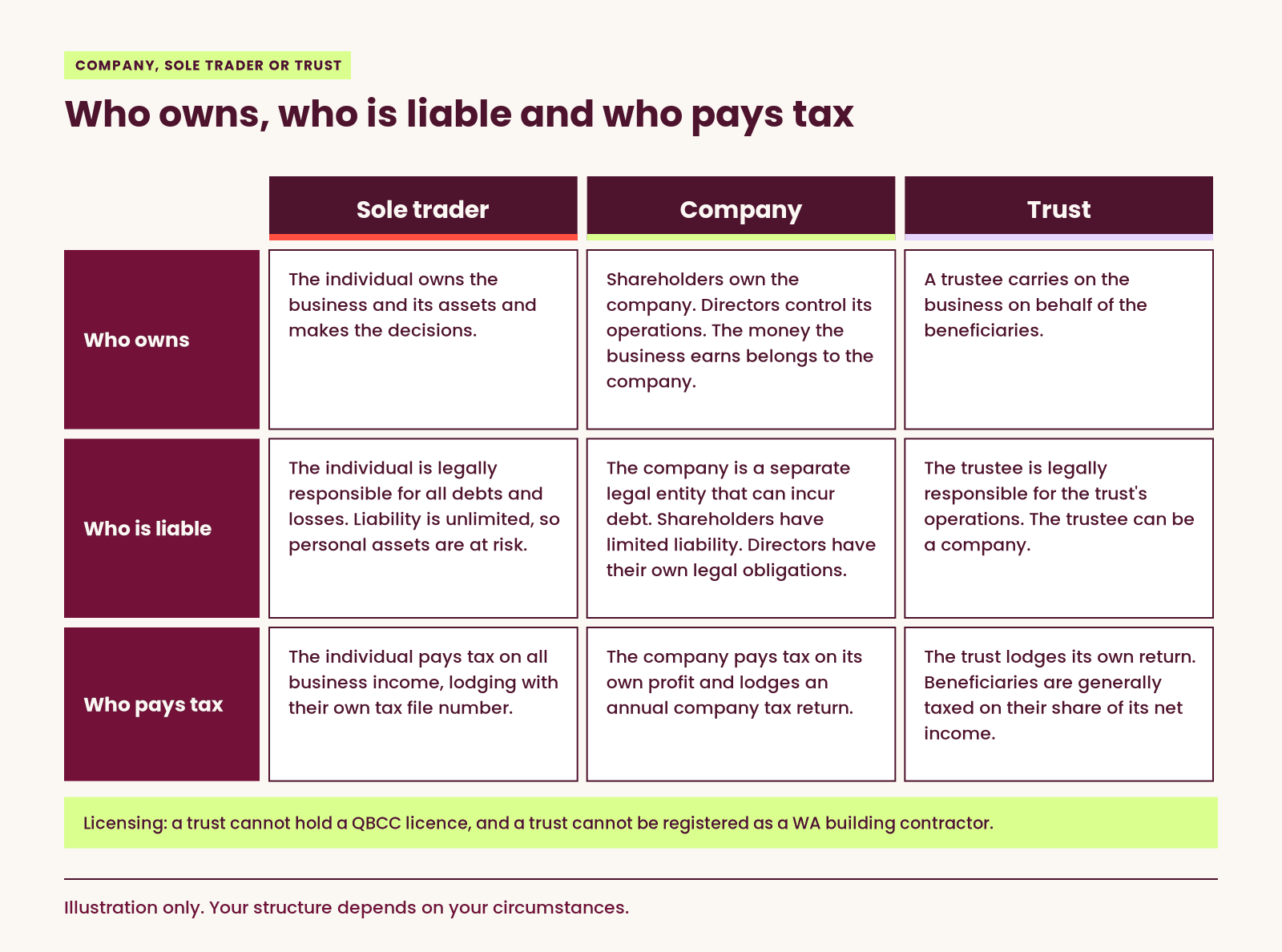
Queensland contractor licensees must meet QBCC’s minimum financial requirements. These have three parts: net tangible assets, a current ratio of at least 1:1 that must be maintained at all times, and a maximum revenue for the licence’s financial category. Loans to related entities and to beneficiaries can affect how net tangible assets are calculated. Licensees in self-certifying categories SC1 and SC2 make a declaration; categories 1 to 7 need an MFR report prepared by an accountant. We prepare MFR reports for QBCC licensees. A trust cannot hold a QBCC licence.
QBCC annual financial reporting
For the licensees it applies to, QBCC annual financial reporting can be lodged from 1 August and is due by 31 December. It is a separate obligation from an MFR report. Which applies depends on the licence, the financial category and the business structure. We prepare and lodge QBCC annual financial reporting for licensees it applies to.
New South Wales
A contractor licence is needed for residential building or trade work valued at more than $5,000 in labour and materials, including GST. That includes work subcontracted as part of a larger job. Where the licensing authority asks for financial information, we prepare it.
NSW Government: general building work
Victoria
Builders must be registered with the Building and Plumbing Commission, which replaced the Victorian Building Authority. Where the Commission asks for financial information, we prepare it.
Building and Plumbing Commission: builder registration
Western Australia
Building contractor registration is needed for building work valued at more than $20,000, or more than $50,000 for class 10a buildings. The Building Services Board generally requires a building contractor to have at least $50,000 in cash or cash equivalents and a quick ratio of at least 1:1. A trust cannot be registered. We prepare the financial reports needed to show these tests are met.
WA Government: building contractor registration
South Australia
A building work contractor’s licence is required, administered by Consumer and Business Services. Where financial information is requested, we prepare it.
SA.GOV.AU: building work contractor’s licence
Tasmania
Building licensing is administered by Consumer, Building and Occupational Services (CBOS). Where financial information is requested, we prepare it.
CBOS: building standards and licensing
Australian Capital Territory
Construction occupation licensing is administered by ACT Planning. Where financial information is requested, we prepare it.
ACT Planning: practitioner regulation
Northern Territory
A building contractor applying for or renewing registration with the Building Practitioners Board must provide an accountant’s net tangible assets certificate showing at least $50,000 in net assets, and must keep that level for the whole registration period. We prepare the net tangible assets certificate.
NT Building Practitioners Board: registration
How your accounts affect licence financial tests
Licence tests are calculated from the balance sheet, so day-to-day decisions can move the result: a loan to a related company or a family trust, how assets and liabilities are classified as current, the timing of a large purchase or a dividend. We look at how those decisions affect the test that applies to you before they are made, and we prepare the report or certificate when it is due, so the licence test is planned for all year rather than met at the last minute.
Business structures and asset ownership for builders
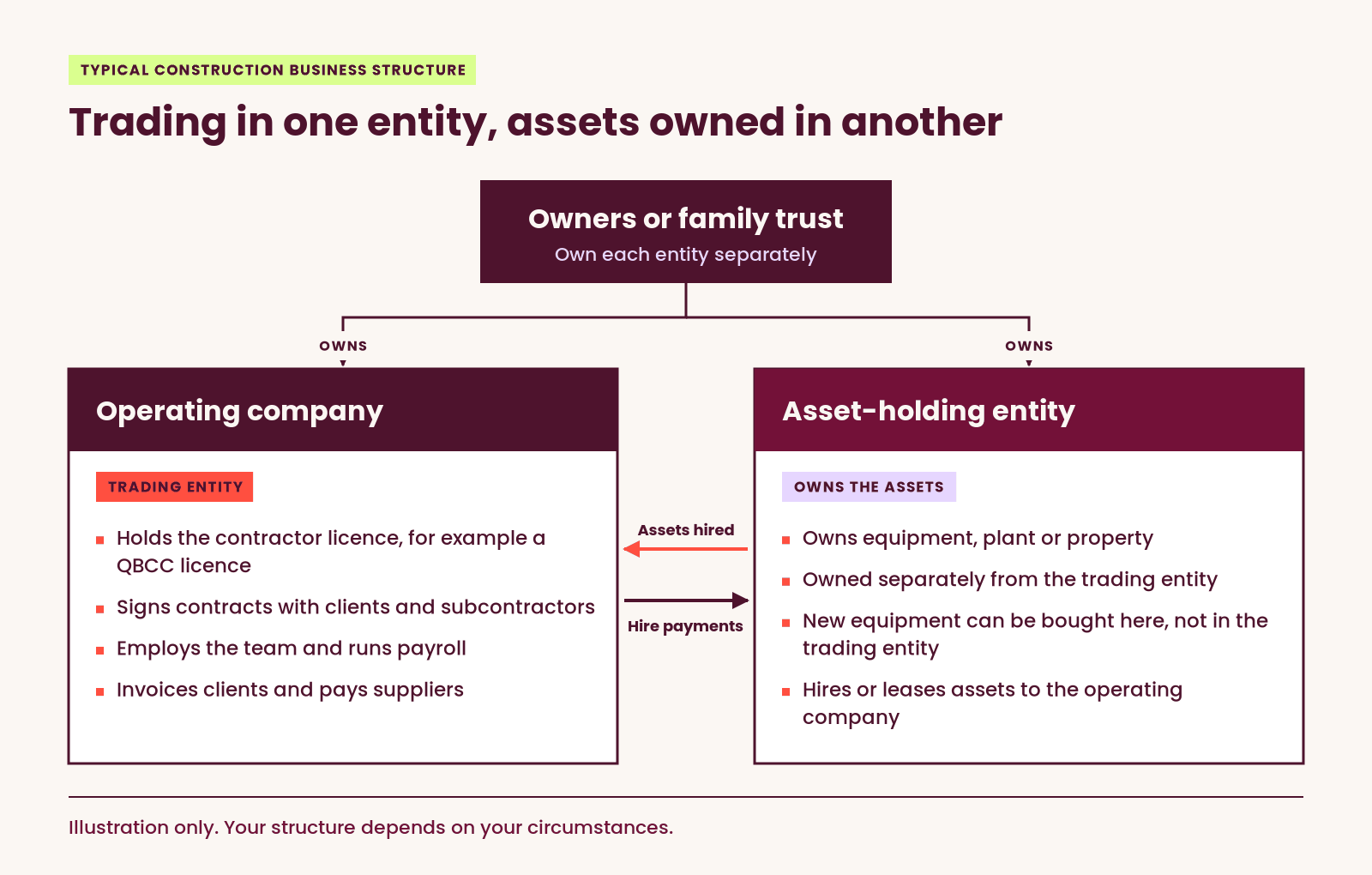
As the business grows, the structure it started with may no longer fit. You may have a trading company, substantial plant, property, a second business or a new owner joining. The accounting questions are where assets and liabilities sit, how money moves between entities, and what the arrangement means for tax, licensing, reporting and finance. In our published turnaround case, equipment had been held inside the trading entity; we set up a separate asset-holding structure so new equipment is bought outside it. Changing ownership or moving assets can create costs and tax consequences, so it is assessed before anything is transferred, with legal advisers involved where needed.
Accounting for construction groups with several entities
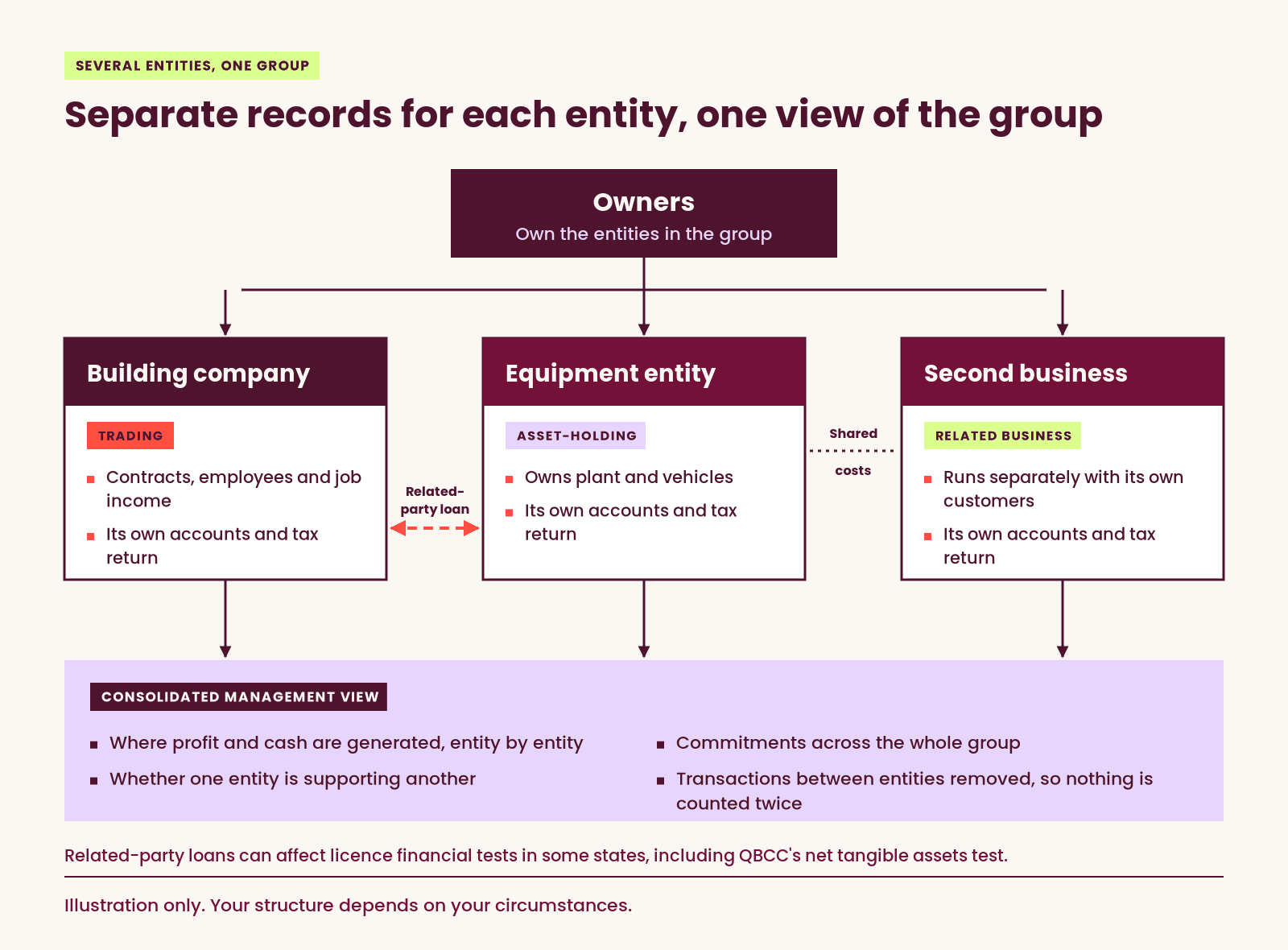
Each entity needs reliable records of its own, and the owner needs to see the commitments across the whole group. We review shared expenses, related-party loans, equipment hire charges between entities and owner transactions, and set up the reporting each part of the business needs. A combined management view shows where profit and cash are generated and whether one entity is supporting another, without double counting transactions between them. Related-party loans also matter for licence financial tests in some states, including QBCC’s net tangible assets test.
Accounting for builders who also develop property
A contractor paid to build for a client and a developer buying land to build and sell face different GST and income tax questions. If you also develop your own projects, tell us at the start. The scope may need to cover land ownership, feasibility assumptions, project funding, property sales and GST, and we confirm the work involved and any specialist advice needed before the engagement begins.
Slow-paying clients, ATO debt and cash pressure in construction
Start with a reliable picture of what is owed, what can realistically be collected and what falls due next. We review the accounts, the cash position and the tax obligations, help set practical priorities and work with you on engaging the ATO. Payment plans depend on the business’s circumstances and are the ATO’s decision. In our published turnaround case, we helped negotiate an affordable ATO payment plan after weather delays, an unpaid customer and accumulated tax debt. If the position calls for formal restructuring or insolvency advice, it needs to go to the right specialist promptly.
Read the turnaround case
SYSTEMS THAT WORK TOGETHER
Construction accounting software: Xero and job management systems
The right setup lets you trace a number from a job to the business accounts and back. We work with Xero and with Dext, AroFlo and Fathom where they suit the business and the agreed scope. Xero tracking categories can report income and costs by job, job type or division. We first look at what you already use, which information is reliable and where work is being done twice. An integration does not guarantee that every job field transfers or that every report is current; cost codes, timing, approvals and reconciliations still matter.




| System | Its role in the accounting workflow |
|---|---|
| Xero | Business accounts, bank reconciliation, invoicing, bills, tracking by job and financial reporting |
| Dext | Capturing and organising receipts and supplier bills for review and coding |
| AroFlo | Job and operational information that can support job costing and accounting workflows |
| Fathom | Management analysis, reporting and forecasting from the financial information |
Record keeping, job coding and reporting responsibilities
Day-to-day record keeping stays with your business. We agree with you and your existing team who handles each part of the records, how those records support BAS, tax, financial statements and management reporting, and who checks what. Clear responsibilities prevent missed work, duplicated fees and reports nobody has reviewed. A team that is doing the right work stays in place.
| Task | Your existing team | Acctivate | Owner |
|---|---|---|---|
| Bank reconciliation and supplier coding | Prepares | Reviews at agreed intervals | Answers coding questions |
| Allocating costs to jobs | Codes to the job | Checks job reports make sense | Confirms job and variation details |
| Payroll and contractor details | Processes | Reviews super, PAYG and TPAR data | Approves timesheets and payments |
| BAS | Prepares the data | Reviews and lodges | Approves and pays |
| Management reporting and forecasts | Supplies current records | Prepares and explains | Makes the decisions |
| Tax returns and financial statements | Supplies year-end records | Prepares and lodges | Reviews and signs |
Example only. Responsibilities are agreed for each engagement.
Construction management reports for jobs, claims and cash flow
The reporting package should reflect the decisions you need to make and the quality of the information available. We agree the format, frequency and responsibilities before the work starts, monthly or quarterly as suits the business.
| Information | The decision it supports |
|---|---|
| Profit and loss and balance sheet | Whether the business is improving and what commitments it carries |
| Estimated completed-job results | Which jobs need attention and what future quotes should allow for |
| Debtors, claims and retentions | What should be collected, and when |
| Supplier, subcontractor and finance commitments | What cash must be available |
| Cash flow forecast | Whether the business can meet its obligations and fund new work |
| Budget against actual | Where assumptions have changed |
| Licence financial test position, where one applies | Whether the balance sheet still meets the regulator’s test |
| Tax position and upcoming obligations | What needs preparing or setting aside |
| Agreed actions from the review | Who will do what next |
A daily operational dashboard and an accountant-reviewed management report do different jobs. Most construction businesses need both.
Find out which jobs are making your building business money
Tell us about your jobs, your team, your equipment and the reporting you have now. We will look at what information is available, what is missing and whether your current accounting support still suits the business.

PUBLISHED CASE STUDY · ELLE GREEN
How a concrete-pumping equipment business grew from $90,000 to $12 million
The owner of a concrete-pumping equipment business started out repairing pumps, turning over about $90,000 a year. Two years into working with Elle Green, an opportunity came up to become the sole Australian dealer for a concrete pump brand. That meant importing expensive equipment and carrying large upfront costs before a single sale came through, and the bank needed a clear picture before committing to finance.
Elle built a detailed cash flow forecast mapping the upfront import costs, build timelines, expected sales and repayments alongside day-to-day trading. That forecast supported the approval of a trade finance facility. As the business grew, Elle set up the deferred GST scheme so GST on imported goods was paid through the BAS rather than at the border, moved the business to monthly BAS lodgements and stayed involved week to week. Over about seven years, annual revenue grew from about $90,000 to $12 million.
$90,000 to $12 million in annual revenue
Trade finance facility approved
Deferred GST on imports
Monthly BAS lodgements
Published case study. Client details are kept confidential. Outcomes depend on individual circumstances.
How an asset-heavy business recovered from a difficult trading year
An established, asset-heavy business had traded successfully for eight years when 2025 went badly: weather delays hit its projects, a major customer stopped paying and ATO debt built up. Revenue was about $3.9 million in FY2025, but the year ended in an operating loss, and the owners were not getting the advice they needed from their previous accountant.
- Helped negotiate an affordable ATO payment plan
- Introduced quarterly advisory meetings to review performance, cash flow and upcoming decisions
- Cleaned up the balance sheet and provided Xero training
- Registered the business for fuel tax credits it had been missing, with almost $39,000 recognised in FY2026
- Set up a separate asset-holding structure, so new equipment is bought outside the trading entity
- Revenue reached about $7.45 million in FY2026, with the business returning to profitability
Published case study. Client details are kept confidential. Outcomes depend on individual circumstances.
CLIENT FEEDBACK
Acctivate reviews from builders, trades and other business owners
Acctivate is rated 5.0 from 200+ Google reviews. The feedback below comes from business owners we work with, including construction and trade businesses.
Google reviews from construction, trade and other clients
★★★★★5 out of 5 stars
I’ve been working with Elle and Simon from Acctivate Business Accountants and I couldn’t be more pleased with the service. They are professional, and always take the time to explain things clearly. Acctivate has consistently gone above and beyond for us. I feel confident knowing that my finances are in such capable hands. Highly recommend to anyone looking for reliable and expert accounting services. Thanks again guys!
Jack Alley
Google review
★★★★★5 out of 5 stars
Simon has provided GQ Electrical with business advice. Very easy to deal with. He will go above and beyond to assist. Highly, highly recommend.
Gus Quatermass
Google review
★★★★★5 out of 5 stars
I’ve recently made the move to Acctivate after starting a Building company a year ago. Running a company obviously comes with the stress of handling the accounting side of things and it had been very daunting until I started working with Simon and Elle. In the space of just a few weeks they have gotten everything up to date and on track. Can happily say I’m sleeping a lot better at night. Their processes and communication is all very transparent and easy to understand. It’s a very nice feeling to have full confidence in my accountant and very excited to work with them moving forward. Can not recommend enough.
Patrick Mulherin
Google review
★★★★★5 out of 5 stars
I can’t recommend Acctivate highly enough. They’re far more than just accountants. They genuinely take the time to listen and understand what the business actually needs.
What stands out is their ability to provide practical, constructive advice that helps you operate effectively while staying compliant.
It’s not just about ticking boxes or doing the numbers. They care about the bigger picture and the long term success of your business.
Sure Solar
Google review
★★★★★5 out of 5 stars
I am a very very happy customer of Accitvate Accountants in Brisbane. Simon really goes above and beyond, and has a level of attention to detail I’ve never come across with any of my previous accountants. He’s very communicative and has follow-through on everything he says he’s going to do. Highly, highly recommend.
Bek Drayton
Google review
★★★★★5 out of 5 stars
Simon is really knowledgeable and incredibly proactive. Working with previous accountants, I have always felt like I need to chase/follow up with them, however Simon is one step ahead and has a great energy!
Mel Johnson
Google review
★★★★★5 out of 5 stars
Great service with Simon. My situation has become more complex over the years and there was a bit to unravel from the previous accountants work. Simon was all over it with a plan.
Prompt, insightful and responsive.
Always open to having a chat and gets things done.
Mark Tran - Write Finance
Google review
★★★★★5 out of 5 stars
Elle has been instrumental in helping our new business set our accounts up correctly from the start, from navigating our reporting and tax obligations, all the way through to best practice for day-to-day business accounting. I highly recommend Elle and the team at Acctivate if you are looking for a switched-on, proactive business accountant.
Danielle Mills
Google review
★★★★★5 out of 5 stars
The team at Acctivate are friendly and approachable. We made the switch from a big firm. We wanted a better relationship with our accountants and it was a breeze. Couldn’t be happier.
Zac Keune
Google review
★★★★★5 out of 5 stars
Elle Green has been my accountant for years and I highly recommend her. I can contact her anytime regarding any queries or concerns to which she replies promptly, and happily gives me her time. She is straight with her feedback, and communicates clearly. Even with my travel abroad, I have remained with Elle and do team meetings when needed. My son, sole trader, is now with Elle, and it has been as seamless as my experience with her. Thanks for all your help Elle!
Leoni Smith
Google review
★★★★★5 out of 5 stars
We have been very happy with the service provided by Acctivate Accountants. Their team is responsive, solution driven and always quick to assist when we need advice or support. They are professional, approachable and take the time to understand our needs, making them a valued partner for our business.
Goldsworthy Private Wealth
Google review
★★★★★5 out of 5 stars
I highly recommend Acctivate Accountants. The entire team is friendly, approachable and easy to deal with. Chloe has been fantastic throughout every interaction, always responding promptly and going above and beyond to help. She makes complex accounting matters easy to understand and is a pleasure to work with. It’s reassuring to know you’re dealing with someone who genuinely cares about achieving the best outcome for her clients.
Nathan McGrath Burgess
Google review
★★★★★5 out of 5 stars
I couldn’t recommend Simon highly enough. His knowledge and understanding of tax strategy, financial decisions and overall financial planning is exceptional.
Whether it’s tax strategy, structuring your finances or simply working through the best options available to you, Simon is incredibly knowledgeable, professional and always willing to help.
I’ve had a fantastic experience dealing with him and would have no hesitation whatsoever recommending Simon to anyone looking for professional financial and tax advice.
Ryan
Google review
★★★★★5 out of 5 stars
Simon was quick to reply and gave us straightforward advice about setting up our business. Kept it super simple, explained the costs clearly and gave us a solid direction to move forward.
Liam Doolan
Google review
★★★★★5 out of 5 stars
Couldn’t recommend the team enough! As a new founder, I’ve definitely had my 101 questions along the way and they’ve always been so helpful and supportive. Ale, my Client Manager is incredible! Always so prompt with her replies and happy to help with whatever I throw her way. Simon and the whole team have also been amazing to deal with! So grateful to have such a great team behind me while I navigate growing Scrub Haus!
Kassi-Lee Feeney
Google review
★★★★★5 out of 5 stars
Simon is a legend – he is actually unreal. Not only a gun accountant but also a top bloke. I have full confidence in my numbers, I can always come to him with questions and he answers them super fast. I finally know exactly where I stand with my business and can scale with confidence and amazing support. Thanks Simon !
Hannes Ortlieb
Google review
★★★★★5 out of 5 stars
I’ve had a great experience working with Simon and the team at Acctivate. They are always responsive, proactive, and focused on delivering the best possible outcomes. Their forward thinking approach and commitment to excellent customer service make them a trusted partner. I highly recommend Acctivate to anyone looking for professional advice and support from a team that genuinely cares about its clients.
Donald McLauchlan
Google review
★★★★★5 out of 5 stars
We were very pleased with the service that Simon provided to setup our business structure. Simon was very friendly, knowledgable and efficient and answered all our questions. He made the process quick and easy and we left feeling very confident with the setup. We highly recommend Simon and his firm.
Sharon G
Google review
★★★★★5 out of 5 stars
Elle has been amazing to work with from the start. She’s friendly, knowledgeable, and incredibly responsive whenever I have questions or needed clarification. Communication was always smooth, and she made everything feel simple and stress-free. You can really tell she cares about her clients and takes the time to explain things clearly. Highly recommend working with her if you want someone reliable, professional, and easy to talk to!
Ella Monzales
Google review
★★★★★5 out of 5 stars
Simon from Acctivate Accountants has honestly been phenomenal – both as a person and supporting us to grow our business and take it to the next level. For me, the standouts are his communication, honesty, transparency and depth of accounting knowledge. I highly recommend Simon and am thankful we found such a fantastic accountant to work alongside!
Chelsea
Google review
★★★★★5 out of 5 stars
Amazing accountants! Cannot recommend Simon and the team highly enough. I had so many questions about setting up my business structure and Simon had all the knowledge to help me understand the best way to handle things.
Nathan Godillon
Google review
★★★★★5 out of 5 stars
I recently used Acctivate to set up my new company and get advice around structure and trademarks. They really focus on doing things properly from the start and setting things up for growth. They didn’t over complicate anything and made sure I understood the next steps I needed to take following our meeting. I will definitely be recommending Simon and Elle to every business I meet from now on
Kate Williams
Google review
★★★★★5 out of 5 stars
Simon was beyond helpful – as someone who is in the early stages of a business to talk through the ways everything should be structured, key common mistakes that if caught early could really help later on and what services do and don’t make sense at this stage. Beyond that he was so supportive and easy to talk to and makes the finance side feel accessible to understand. Thank you!
Eleanor P
Google review
★★★★★5 out of 5 stars
Simon from Acctivate has been a great asset to our business. I took my time to find the right accounting firm and I’m glad I did. Acctivate has a strong focus on business development combined with accounting to really focus on growing businesses. Simon has been available when I needed him and provides the valuable information to help me make more tax informed business decisions. Highly recommend reaching out and connecting with Simon and his team.
Andrew Barrett
Google review
YOUR ACCOUNTING TEAM
Meet the accountants behind your construction business advice
Elle Green CA
Director and Co-Founder
Elle is a Chartered Accountant and Registered Tax Agent with over a decade of experience supporting small businesses, specialising in small business taxation and cash flow management. She holds a Bachelor of Commerce and a Xero Advisor certification, and she is the accountant in our published concrete-pumping case. Elle was named the winner of Accounting Consultant of the Year at the Women in Finance Awards 2025.
Meet Elle

Simon Burke CA
Director and Co-Founder
Simon is a Chartered Accountant working across accounting and business advisory. His focus is helping businesses build strong foundations through better cash flow, smarter structures and practical efficiency, which is most useful when a business has outgrown its original setup.
Meet Simon

Chloe Sullings CPA
Business Specialist
Chloe is a CPA with over a decade of experience, from boutique practices to top 100 firms. She breaks complex accounting information down so owners understand it and know which questions it raises for the business.
Meet the team
Why builders choose Acctivate as their construction accounting firm
01
Forecasting experience you can examine
Elle is the accountant named in a published equipment-business case involving large upfront costs and growth funding. You can read the work before you discuss your own business.
Read the case
02
Relationships with construction-related businesses
Bitumen Co., JR Equipment, GQ Electrical and Sure Solar are among the civil, equipment, electrical and solar businesses we work with.
03
Named people and a clear working arrangement
You know which Chartered Accountant is responsible for your work, who else is involved, and how queries, records and reviews are handled.
04
Reporting tied to a decision
Each report is built to answer a question, such as whether a job is earning its intended margin or whether the business can fund a new commitment, and each review ends with agreed actions.
05
Agreed scope and fees
The agreement separates ongoing accounting from initial clean-up, systems work and advisory projects, so you know what is included and how your own team fits in.
WORKING WITH ACCTIVATE
How to switch accountants for your construction business
Understand the business
We discuss the work you do, your team, systems, entities, the states you work in and your immediate concerns.
Review the information
We establish what the accounts and job records currently show, where information is missing and which obligations need attention.
Agree the work and fees
We confirm responsibilities, reporting, tax work, advisory requirements and any initial clean-up or project work, with a fixed monthly fee for the ongoing work.
Put the arrangement into practice
We coordinate the handover from your previous accountant, the systems and the information flow the agreed service needs.
Review and act
We explain the results, discuss changes in the business and agree practical next steps at the intervals set in your engagement.
Changing accountants while projects keep running
You do not need to wait until the end of the financial year to change accountants. We start with the current position: entities, accounting files, outstanding lodgements, records, job systems and upcoming deadlines, including any licence reporting date. We then agree the handover and authorisations needed with your existing accountant, and identify any catch-up work in the scope. The systems and people that are working well can stay in place while the arrangement changes.
Working with construction businesses outside Brisbane
Our office is in Fortitude Valley, Brisbane, and that is where in-person meetings take place. For businesses elsewhere in Australia, we work through cloud accounting and online meetings, so the financial work and the conversations continue without anyone needing to visit the office. For interstate work, we establish which state obligations affect the engagement; Queensland rules are never applied to a business simply because its accountant is in Brisbane.
How construction accounting fees are set
Our ongoing accounting engagements use a fixed monthly fee, agreed around the scope before the work starts. Initial corrections, system changes, formal reports and separately scoped advisory projects are identified and priced in the agreement, so nothing is added without discussion.
The fee depends on:
- The number of entities and how they relate to each other
- The condition of the records and how much catch-up work is needed
- Payroll, employees and contractor arrangements
- BAS, TPAR and other lodgement obligations
- State licence financial reports we prepare, where they apply, such as QBCC MFR reports and annual financial reporting
- The reporting package and how often we review it with you
- Forecasting, structuring and other advisory work
The first conversation establishes whether we are the right fit and what the scope is likely to involve.
Brisbane construction accountants for builders across Australia
We work with construction and trade businesses in every Australian state and territory, online. Federal obligations such as income tax, GST, super and the TPAR are the same everywhere; security of payment, licensing and payroll tax rules change at the border. We check which state’s rules apply when we scope the work.
Queensland
Brisbane, Gold Coast, Sunshine Coast, Toowoomba, Townsville, Cairns.
QBCC and the BIF Act.
New South Wales
Sydney, Newcastle, Central Coast, Wollongong.
The NSW Security of Payment Act and contractor licensing.
Victoria
Melbourne, Geelong, Ballarat, Bendigo.
The amended Security of Payment Act from 15 April 2026.
Western Australia
Perth.
The Security of Payment Act 2021 and building contractor registration.
South Australia
Adelaide.
The Security of Payment Act 2009 and the building work contractor's licence.
Tasmania
Hobart, Launceston.
The Security of Payment Act 2009 and CBOS licensing.
Australian Capital Territory
Canberra.
The Security of Payment Act, amended from March 2024.
Northern Territory
Darwin.
The Construction Contracts Act and Building Practitioners Board registration.
Our office is in Fortitude Valley, Brisbane
Level 5/ 269 Wickham St, Fortitude Valley. Monday – Friday, 8:30am – 5pm (Queensland time). In-person meetings take place at our Fortitude Valley office; we meet businesses everywhere else online.
QUESTIONS BEFORE YOU ENQUIRE
Construction accounting FAQs
The business
What does a construction accountant do?
A construction accountant looks after your tax, BAS and financial statements, and also helps you understand the business job by job: what each job is earning, what cash the next contract needs, and what tax, super and licence obligations your decisions create. At Acctivate, that work sits inside an ongoing engagement with a fixed monthly fee and agreed reviews, led by Chartered Accountants.
Our business accounting and advisory services
Can you work with our existing office team and systems?
Yes. Day-to-day record keeping stays with your business, and a team that is doing the right work stays in place. We agree who handles supplier coding, job allocation, payroll and contractor details, and how those records support BAS, tax, financial statements and management reporting. Clear responsibilities prevent missed work, duplicated fees and reports nobody has checked.
Systems that work together
Is a 25% markup the same as a 25% margin?
No. Markup is calculated on cost and margin on the selling price. A 25% markup on $100 of cost gives a $125 price and a $25 contribution, which is a 20% margin. To earn a 25% margin on $100 of cost, the price needs to be about $133.33. Pricing on markup and judging results on margin makes every job look worse than planned.
Labour recovery and markup versus margin
Why does the business show a profit but have little cash?
Profit and cash measure different things. Unpaid claims, retentions held back, materials bought ahead, equipment purchases, loan principal, tax payments and the timing of supplier payments all affect the bank balance without changing profit in the same way. A review reconciles profit to cash and shows which of these is holding the money, so you know what to change.
Cash flow across jobs
What information do you need to review unfinished jobs?
Useful records include the contract value, approved variations, variations still being negotiated, progress claims, costs already incurred, committed costs not yet invoiced and a realistic estimate of the work and cost remaining. With these, work in progress can be measured properly and each job’s expected margin at completion compared with the margin in the original quote.
Job costing and WIP
How should retentions show up in our accounts?
Retentions are money you have earned but cannot use yet, so they should be tracked separately from other debtors, job by job, with the conditions and expected release dates. That keeps them out of the cash you plan to spend and stops them being forgotten at practical completion. In Victoria, retention money can now be claimed as a performance security under the amended security of payment scheme.
State security of payment rules
Can you help us decide whether we can afford a new machine or another crew?
Yes. We model the full cost, including the deposit, repayments, insurance, servicing, wages, super and supervision, against the work expected to keep the machine or crew busy, and show the effect on cash month by month. That lets you see whether the commitment pays for itself and when the business would feel the pressure.
Equipment and finance
Do we need to lodge a TPAR?
If your business pays contractors for building and construction services, and those services make up 50% or more of your income or activity in the current or previous year, you are likely to need to lodge a taxable payments annual report. It is due by 28 August each year. We review the position against the ATO’s tests and check that contractor records are complete.
BAS, GST and TPAR
If a subcontractor has an ABN, do we still have to pay their super?
Possibly. If you pay an individual contractor wholly or principally for their labour, super guarantee can apply even though they quote an ABN. A contractor operating through a company, trust or partnership is generally outside this rule. Under Payday Super, contributions must reach the fund within 7 business days of payday, so the arrangement needs checking before the next pay run.
Employees, subcontractors and super
When does payroll tax start to apply to a construction business?
Payroll tax is a state and territory tax, and each sets its own threshold. Queensland and New South Wales measure the threshold against Australian wages, so wages paid interstate count. Queensland currently offers a rebate on eligible apprentice and trainee wages. We check where your business pays wages, how close it is to the threshold that applies, and plan for the cost before it arrives.
Employees, subcontractors and super
Can our business claim fuel tax credits?
Possibly. Fuel used in machinery, heavy vehicles and equipment for eligible business activities, including travel off public roads, can attract fuel tax credits. You need to be registered for GST and for fuel tax credits, and keep records of how the fuel was used. In one published case, we found almost $39,000 in credits a business had been missing, recognised in FY2026.
Read the turnaround case
Is QBCC annual financial reporting the same as an MFR report?
No. QBCC annual financial reporting is a yearly obligation for the licensees it applies to, which can be lodged from 1 August and is due by 31 December. The minimum financial requirements cover net tangible assets, a current ratio of at least 1:1 at all times and maximum revenue. Categories 1 to 7 need an MFR report prepared by an accountant, while SC1 and SC2 licensees make a declaration. We prepare both MFR reports and annual financial reporting.
Licensing and financial tests
Which security of payment Act applies to our job?
Each state and territory has its own security of payment Act, with its own due dates for progress payments and payment schedules. Two changed recently: Victoria’s from 15 April 2026 and the ACT’s from 11 March 2024. Check your contract as well, because many contracts set an earlier date than the Act. We confirm which rules apply to each contract when we scope the work.
Progress claims across Australia
Do you advise construction businesses that also develop property?
Building for a client and developing your own property raise different GST and income tax questions. If you develop as well as build, tell us at the start. The work may need to cover land ownership, feasibility assumptions, project funding, property sales and GST, and we confirm the scope and any specialist advice needed before the engagement begins.
Building versus property development
Working together
Do you work with construction businesses in my state?
Yes. We work with construction and trade businesses in every state and territory: Queensland, New South Wales, Victoria, Western Australia, South Australia, Tasmania, the ACT and the Northern Territory. Our office is in Fortitude Valley, Brisbane, where in-person meetings take place. Everywhere else, we work through cloud accounting and online meetings, from Sydney and Melbourne to Perth, Adelaide, Hobart, Canberra and Darwin.
Working across Australia
Do I need an accountant based in my own state?
Not necessarily. Income tax, GST, super, PAYG and the TPAR are federal and work the same way in every state. What changes at the border is security of payment, licensing and payroll tax. We identify which state rules apply to each contract, prepare the licence financial reports your regulator asks for, and never apply Queensland rules just because our office is in Brisbane.
State security of payment rules
Do we have to change our job management software?
Not automatically. We first look at the current workflow, the records it produces and the reporting you need. We work with Xero and with Dext, AroFlo and Fathom where they suit the business. Any proposed change should fix an identified problem, such as costs not reaching the right job or information being entered twice.
Systems that work together
Is our business the right size for Acctivate?
Our ongoing service is designed for established construction and trade businesses turning over $400,000 or more. Turnover is one indicator. A team or regular subcontractors, several jobs running at once, equipment or finance commitments, and more than one entity also point to a good fit. If you only need a basic annual lodgement, another service is likely to suit you better.
When Acctivate is likely to be the right fit
How often would we review the numbers together?
We agree the review schedule with you, usually monthly or quarterly, depending on job activity, the quality of the information and the decisions ahead. Not every engagement needs the same meetings or reports. In our published turnaround case, for example, we meet the owners every quarter to review performance, cash flow and upcoming decisions.
What useful reporting can include
How are your fees set?
Ongoing work is charged as a fixed monthly fee agreed around the scope. The main factors are the number of entities, the condition of the records, payroll and contractor arrangements, lodgement obligations, any state licence reporting, the reporting package and advisory work. Initial clean-up or separately scoped projects are identified and priced in the agreement before they start.
Fees based on the work your business needs
Can we change accountants part-way through the year?
Yes. You do not need to wait until 30 June. We establish what your current accountant has completed, what is outstanding, the upcoming lodgement and licence reporting dates, and the authorities needed for the handover. Work already underway is either finished by your current accountant or taken over as part of an agreed transition plan, so deadlines are not missed.
How the engagement starts
What should we prepare for the first conversation?
Tell us what the business does, the states you work in, approximate annual turnover, team size, the entities involved, the systems you use and the main issue you want help with. Detailed financial records are not needed for the first conversation; if we are a good fit, we request them as part of reviewing the information.
Discuss Your Construction Business
Who are you not the right fit for?
Our ongoing service is not designed for individual employee or apprentice tax returns, basic once-a-year lodgements or businesses under $400,000 that want the lowest-cost compliance. We also do not act as insolvency practitioners, construction lawyers, auditors, finance brokers or workplace-relations advisers. Where you need one of those, we tell you early and work alongside them on the accounting side.
When another service may suit you better
What happens after we send an enquiry?
We review your enquiry and contact you to discuss your business and the support it needs. That first conversation establishes whether Acctivate is the right fit, what the scope is likely to involve and what the next step would be. If another type of adviser would suit you better, we will say so.
Call (07) 3185 5303
Construction accounting services and resources
Business accounting and advisory
Ongoing accounting with reporting and advice built in.
Tax planning and compliance
Forward tax planning, BAS and lodgements.
Structuring and asset protection
Entities, ownership and where assets sit.
Software for SMEs
Xero and connected systems set up to produce usable reports.
Accounting for multiple businesses
Several entities, one clear view.
Accounting for trades businesses
Our guide to the numbers that matter in a trade business.
LET'S TALK
Request a construction accounting consultation
If you are managing more work, more people or bigger commitments and need clearer financial direction, tell us what is happening. We will discuss your situation, establish whether Acctivate is the right fit and explain the next step.
Led by Chartered Accountants Elle Green and Simon Burke.
We review every enquiry and contact you to discuss your business and the support it needs.
We use your details only to respond to your enquiry.
This page contains general advice and information only. It does not take your personal circumstances into account and is not a recommendation to take or avoid any action. Rules and thresholds change, so speak to us or another qualified adviser about your situation. Case study results are specific to those clients and do not guarantee a similar outcome.
ACCTIVATE PTY LTD · ABN 63 677 493 882 · Level 5/ 269 Wickham St, Fortitude Valley · (07) 3185 5303
