
ACCOUNTING FOR TRADE BUSINESSES
Accountants for Tradies and Trade Businesses
Tradie accountants for established trade businesses turning over $400,000+: electricians, plumbers and gasfitters, air-conditioning and refrigeration, solar installers, carpenters, painters, roofers, tilers, plasterers, bricklayers, landscapers, fencers, glaziers, welders, mechanics and every other trade. We help you see what each job and each van earns, cost apprentices and crews properly, and stay ahead of tax, GST, super and licence financial reporting.
Based in Fortitude Valley, Brisbane, working with trade businesses around Australia.
★★★★★5 out of 5 stars
Chartered Accountant-led
Elle Green CA and Simon Burke CA, the directors of Acctivate, lead the work for every trade business we take on.
Meet the team
Xero-certified advisers
Job, crew and van reporting set up in Xero, so the figures you quote from are the figures in your accounts.
Xero and job software
Registered Tax Agent
Tax work for your trade business is carried out under the professional obligations of the Tax Agent Services Act.
TASA disclosure statement
Accounting Consultant of the Year 2025
Elle Green won Accounting Consultant of the Year at the Women in Finance Awards 2025.
See the 2025 results
Meet Elle
BUSY ISN'T THE SAME AS PROFITABLE
Accounting built around how trade businesses actually run
A trade business can run dozens of jobs a week, buy materials before the customer pays, carry stock in every van and pay apprentices for hours nobody bills. Domestic customers pay late, builders pay on their own cycle, and BAS, super and wages fall due regardless. Our trade business accountants connect those day-to-day realities with the numbers you use to price, hire and plan.
Know what each job and each van earns
Separate service calls, installs and project work so you can see which type of work actually pays.
Charge-out rates and job pricing
Price for the real cost of the crew
Count super, leave, travel, quoting time and unbillable hours before you set a rate or take on another apprentice.
The real cost of the team
Stay ahead of BAS, super and wages
Map quiet months, supplier accounts and tax payments so the money is there when each one falls due.
Cash flow through a tradie’s year
Grow from sole trader to a team without surprises
Know which registrations, taxes and structure questions arrive with the first employee, the second van and the second crew.
From sole trader to a crew
EVERY TRADE
Tradie accountants for every trade
The tax rules are the same for every trade. The economics are not. A locksmith’s margin comes from small jobs and stock; a pool builder’s comes from a handful of large contracts and plant. These are the trade groups we work with, and what tends to drive the numbers in each.
Electrical and energy
Electricians and electrical contractors, solar and battery installers, and data and communications cablers. Service calls, switchboard upgrades, new installs and commercial project work often run through the same business at very different margins. Solar and battery installs add supplier deposits, panels and inverters on the shelf, and warranty call-backs, often before the customer’s final payment arrives. GQ Electrical and Sure Solar are among the electrical and solar businesses we work with.
Plumbing, gas and air
Plumbers, gasfitters, drainers, roof plumbers, and air-conditioning, HVAC and refrigeration mechanics. After-hours call-outs, scheduled maintenance and new installations each recover the van, the parts and the plumber’s time differently. Air-conditioning and refrigeration businesses also carry equipment-heavy installs alongside maintenance contracts, and need a Refrigerant Trading Authorisation to buy and store refrigerant.
Carpentry and structural trades
Carpenters, joiners and cabinetmakers, bricklayers and blocklayers, and scaffolders. Labour-only work and supply-and-install work need different pricing, and a joinery workshop has rent, machinery and offcuts to recover before its first cabinet leaves the door. Scaffolders carry a yard of equipment whose cost has to be priced into every hire.
Builders and project contractors
Finishing trades
Painters and decorators, plasterers and renderers, tilers, floor layers, glaziers, waterproofers and roofers. Quotes are often priced by the square metre on materials-heavy jobs, so a measuring error or a price rise between quote and start comes straight off the margin. Much of the work runs to a builder’s schedule, and roofers and exterior painters lose days to weather.
Outdoor and property trades
Landscapers, fencers, pool builders, irrigation installers, arborists and tree services, and paving contractors. The work is seasonal and weather-exposed, large domestic jobs often run on deposits and stage payments, and machinery such as mini excavators, stump grinders and chippers needs enough booked hours to cover its finance, servicing and tip or disposal costs.
Metal, mechanical and automotive trades
Welders and metal fabricators, boilermakers, mechanics, auto electricians and locksmiths. Workshop rent, equipment and parts stock sit behind every hour sold, and many of these businesses mix workshop work with mobile or on-site jobs at different rates. The mix also matters for reporting: workshop repairs and on-site installation can be treated differently for the ATO’s taxable payments report.
Don’t see your trade listed? Licensed and service trades not named here are covered too; tell us about your business through the form. Builders, concreters, formworkers and civil contractors: see our construction accountants page.
construction accountants
When Acctivate is likely to be the right fit
Turnover and stage matter more than the trade. You’re likely to be a good fit if most of these describe your business:
- Any trade: electrical and energy, plumbing, gas and air, carpentry and structural, finishing, outdoor and property, or metal, mechanical and automotive
- Annual turnover of $400,000+
- Apprentices, employees, regular subbies, or a mix
- Vans or utes on the road, some of them on finance
- A company, a trust or more than one entity, or you’re about to need one
- Xero in use, or a plan to move to it
- You want to talk through the numbers during the year, not only when the tax return is due
- Based anywhere in Australia
When another service may suit you better
Saying so early saves you time. Our ongoing service is likely to be the wrong kind of help if:
- You need only an individual tax return as an employee or apprentice in any trade. A tax agent who prepares individual returns will suit you better.
- You’re a sole trader turning over less than $400,000 and the priority is the lowest-cost lodgement.
- You’re a builder or project contractor whose main questions are progress claims, security of payment and builder licensing. Our construction accountants page covers that work.
- You need insurance (an insurance broker), debt recovery or a contract dispute handled (a lawyer), a loan (a finance broker), or a ruling on whether a worker is an employee under an award (a workplace-relations adviser).
Some of the trade businesses we work with
GQ Electrical, an electrical contracting business, and Sure Solar, a solar installation business, are two of the trade businesses we work with.
What usually brings a tradie to us
Most trade business owners don’t arrive with a neat accounting question. They arrive with one of these.
| What you’re noticing | What needs looking at | Where this page covers it |
|---|---|---|
| You’re flat out, but the bank balance doesn’t move | Debtor days, supplier terms, materials bought ahead, tax and super set aside, owner drawings | Cash flow through a tradie’s year |
| Quotes are winning work, but the jobs don’t seem to pay | Billable hours against paid hours, travel and quoting time, materials pricing | Charge-out rates and job pricing |
| A plumber taking on a first apprentice | The apprentice’s full cost against the hours they can bill, and the registrations an employer needs | The real cost of the team |
| An electrician adding a second van and a second tradesperson | The van’s whole-of-life cost per working hour, and whether the extra work covers both | Vans, utes, tools and stock |
| A painter hiring a first employee instead of using subbies | Employee or contractor, super, PAYG withholding and Single Touch Payroll | From sole trader to a crew |
| Moving from sole trader to a company | Liability, tax, licence holding and the cost of changing | Business structures |
| BAS, super or PAYG has fallen behind | What is owed, what falls due next and what the ATO needs to hear | Slow payers and tax debt |
| An air-conditioning business’s tax bill is far bigger than expected | The year’s forecast, PAYG instalments and how owners are paid | Tax planning |
| A roofer’s licence renewal needs financial information | The balance sheet the regulator relies on | Trade licences and financial reporting |
| A landscaper’s winter slowdown, or a run of wet weeks | A 13-week cash view through the quiet stretch | Cash flow through a tradie’s year |
| A mechanic running the workshop and a second business, such as a property or equipment entity | Loans and charges between the entities and one combined view | Business structures |
| You only hear from your accountant at tax time | A reporting rhythm and a review arrangement that suit the business | How working together starts |
AS THE BUSINESS GROWS
From sole trader to a crew: what changes as a trade business grows
Most trade businesses we meet have grown faster than their set-up. Each stage below brings new obligations and new numbers to watch. The trades in each example are illustrations; the same points apply to every trade.
On the tools on your own
Picture a tiler working alone with an ABN, a ute and a supplier account. At this size the business is already past the point where GST registration is required, which is a GST turnover of $75,000 or more. The focus is clean records, setting aside GST and income tax from every payment, and knowing whether the work you quote covers the days spent measuring, buying and driving. It’s also the point to understand how a sole trader is taxed, and what changing structure later would involve.
The first apprentice or employee
A plumber taking on a first-year apprentice becomes an employer. That means registering for PAYG withholding before the first payment that needs withholding, reporting payroll through Single Touch Payroll, paying super guarantee to a fund for eligible workers, and holding workers’ compensation insurance under the scheme in your state or territory. From 1 July 2026, Payday Super requires each super guarantee contribution to reach the employee’s fund within 7 business days of payday, with longer in some situations, so super becomes part of every pay run’s cash. We cost the hire before it happens and check the business can carry it through the apprentice’s least productive months.
A crew, more vans and an office
An electrical contractor with four tradespeople, two apprentices, five vans and someone running the office needs reporting by job type and by crew, not just a profit figure at year end. Payroll tax becomes a live question: it’s a state or territory tax, each one sets its own threshold, and it’s measured against total Australian wages, so a business with workers across a border needs to watch both. If vans are available for private use, fringe benefits tax can apply. This is usually when a structure review and monthly or quarterly reporting earn their keep.
Several crews, a manager, more than one entity
An air-conditioning business with install and maintenance crews, a general manager and a separate entity that owns the vehicles and the workshop needs the group to be read as one. Each entity keeps its own records and lodgements; the owners need a combined view of profit, cash and what one entity owes another. Licence financial reporting, payroll tax across states and loans between related entities all need planning before year end, not after.
| Stage | What usually changes | What we look at |
|---|---|---|
| On your own | GST registration, records, setting money aside | Pricing that covers unbilled time; the timing of any structure change |
| First apprentice or employee | PAYG withholding, Single Touch Payroll, super guarantee and Payday Super, workers’ compensation | The full cost of the hire against its billable hours; the cash effect of super on every pay run |
| A crew, more vans and an office | Payroll tax thresholds, possible FBT on vans, more supplier and customer accounts | Reporting by job type, crew and van; a structure review |
| Several crews and entities | Group reporting, related-party loans, licence financial tests, payroll tax across states | One combined view; year-end planning across every entity |
Business structures for trade businesses
Trade work carries real liability: a wiring fault, a failed waterproofing membrane or an injured worker can become a claim against the business. Structure is one of the ways owners manage that exposure, alongside insurance arranged through a broker. It also decides how profit is taxed, who can hold the licence and how much administration the business carries. What follows is general information about how the options work; the right structure depends on your circumstances.
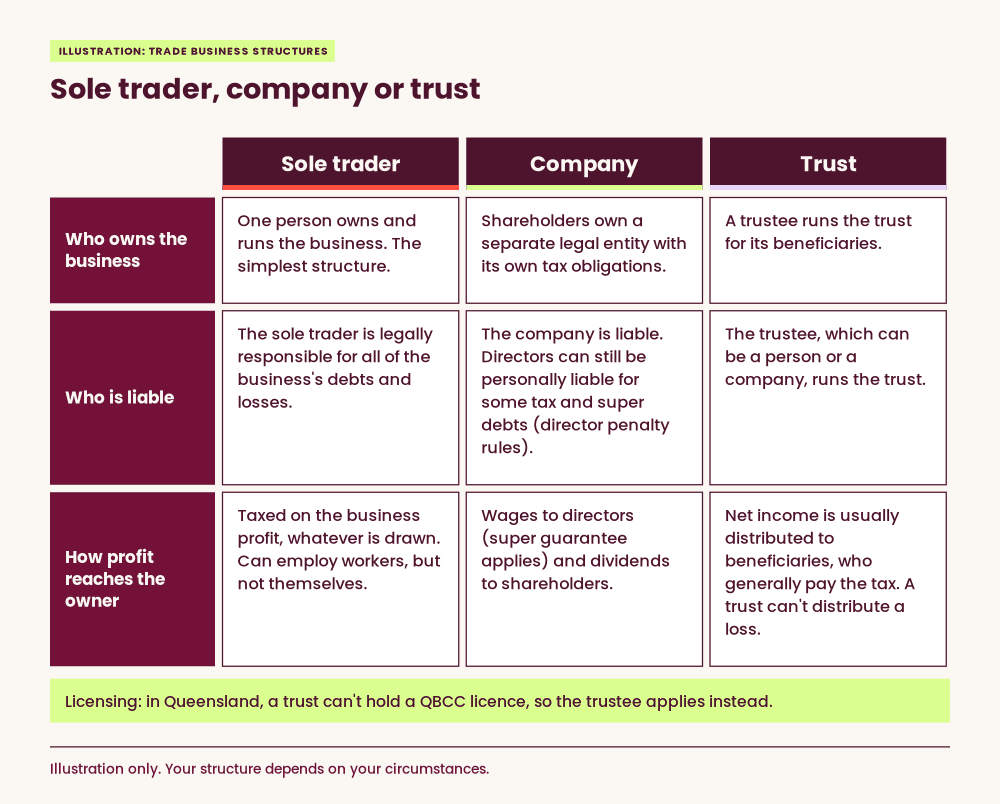
Sole trader, company or trust
A sole trader is the simplest structure and is legally responsible for all of the business’s debts and losses. A sole trader can employ workers but can’t employ themselves. A company is a separate legal entity with its own tax obligations; it pays super guarantee for eligible workers, including directors, and can distribute profit to its shareholders as dividends. Its directors can still be personally liable for some of the company’s tax and super debts under the director penalty rules. A trust is run by a trustee, which can be a person or a company, and its net income is usually distributed to beneficiaries, who generally pay the tax on it. A trust can’t distribute a loss. Licensing matters too: in Queensland, a trust can’t hold a QBCC licence, so the trustee applies instead.
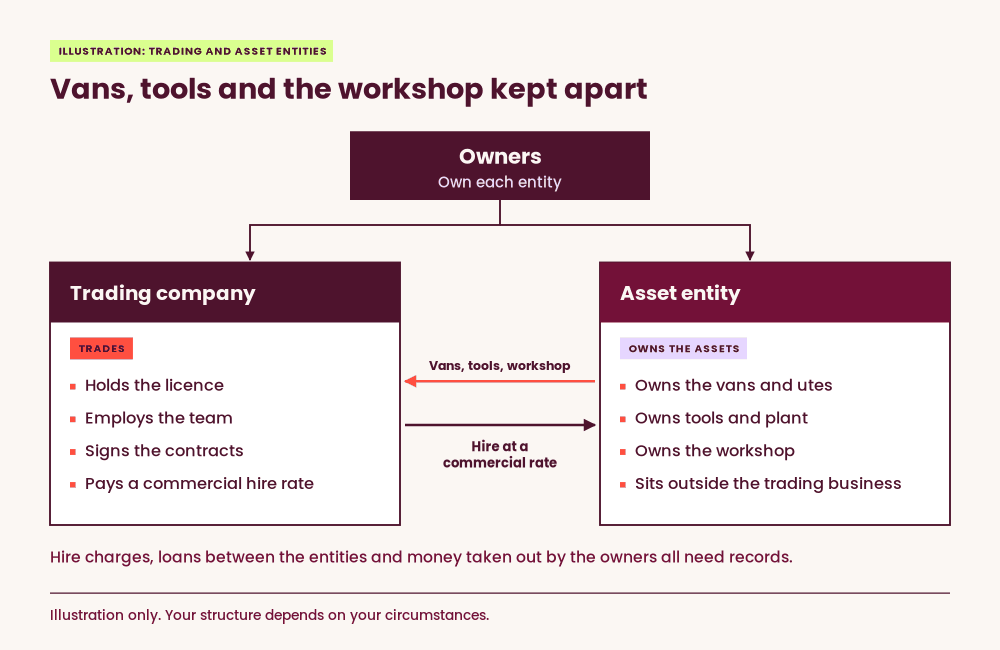
Keeping vans, tools and property apart from the trading business
Some trade businesses keep the trading company, which holds the licence, employs the team and signs the contracts, separate from an entity that owns the vans, tools, plant or workshop and hires them to the trading company at a commercial rate. If the trading business has a bad claim or a bad year, those assets sit outside it. The arrangement only works if it’s documented and run properly: hire charges, loans between the entities and money taken out by the owners all need records. When a private company lends money to its shareholders or their associates, Division 7A can treat the loan as a deemed dividend unless it is repaid, or put on a written complying loan agreement, before the company’s tax return is due or lodged. Moving existing assets between entities can carry costs and tax consequences of its own, so it’s assessed before anything is transferred.
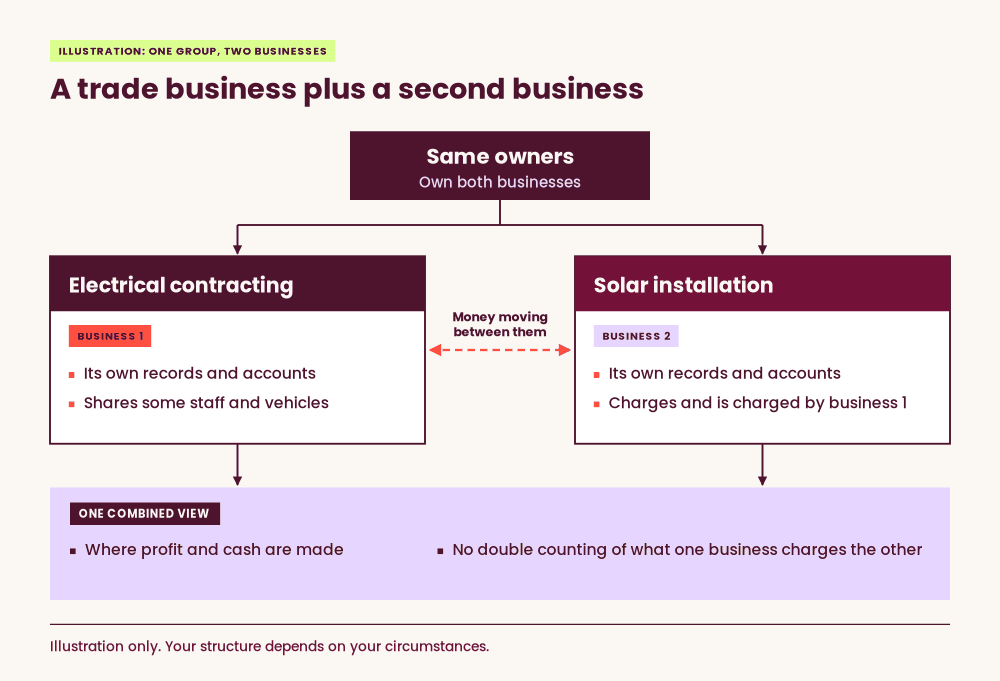
More than one business under the same owners
An electrical contractor that starts a separate solar installation business, or a plumber who buys a drainage business, ends up with two sets of records, shared staff and vehicles, and money moving between them. Each entity needs accurate accounts of its own, and the owners need one combined view that shows where profit and cash are made without double counting what one business charges the other.
PRICING
Charge-out rates and job pricing that cover the real cost
Most underpricing in trade businesses doesn’t come from an hourly rate that is a little low. It comes from pricing every paid hour as if it were billable, and from treating very different kinds of work as if they earned the same margin.
What an hourly or call-out rate has to cover
A charge-out rate has to recover far more than the tradesperson’s wage: super, leave, workers’ compensation, insurance, the van and its fuel, tools and consumables, phones and software, and a share of the office. It also has to cover the hours that are paid but never billed: driving between jobs, picking up from the supplier, restocking the van, quoting, call-backs and the odd quiet morning. That’s why the number that matters is billable hours, not paid hours.
Illustration only. All figures are assumptions chosen to show the method, not award rates or industry benchmarks. Figures exclude GST, business overheads and profit.
| Item | Assumption | Result |
|---|---|---|
| Paid hours in the year | 2,000 hours | 2,000 |
| Paid hours not at work (leave, public holidays, training, sick days) | 280 hours | 1,720 hours at work |
| Hours at work but not billable (travel, supplier runs, quoting, call-backs, restocking) | 400 hours | 1,320 billable hours |
| Billable hours as a share of paid hours | 1,320 ÷ 2,000 | 66% |
| Full annual cost of the tradesperson, van and tools | $150,000 | |
| Cost per paid hour | $150,000 ÷ 2,000 | $75.00 |
| Cost per billable hour | $150,000 ÷ 1,320 | $113.64 |
- A rate built on $75.00 an hour recovers only about two-thirds of this tradesperson’s cost, before the business has covered its office or made a profit.
- Lifting billable hours to 1,480, about three more billable hours a week, brings the cost per billable hour down to $101.35. Better scheduling and fewer supplier runs can matter as much as a higher rate.
- Your own figures will differ. The method is what carries across.
Service, install and project work earn different margins
Take an electrical business that does service calls, new installs and a few commercial fit-off jobs. The service call carries a call-out fee and a high hourly rate, but also the most travel and unbillable time. The install is often fixed-price, so its margin depends on how accurately the hours and materials were estimated. Project work for a builder runs at a lower rate but books the crew for weeks at a time. Fixed-price and do-and-charge jobs carry different risks, and maintenance contracts trade a lower rate for predictable work. When all of it lands in one income line, the owner can’t see which part of the business is carrying the rest. Reporting each type of work separately is usually the first change worth making.
Materials markup and margin
Materials are a profit line, not just a pass-through cost, and the price you pay can move between the quote and the job. Two points matter most: whether quotes are updated when supplier prices change, and whether the business is pricing on markup and then judging results on margin, which are not the same number. Our construction page sets out the difference with a worked example.
markup versus margin
Apprentices, employees and subcontractors: the real cost of the team
The team is usually the biggest cost in a trade business and the hardest one to price. Each way of engaging people has its own tax, super and employment rules, and those rules are applied to the real working relationship, not to what the paperwork calls it.
What an apprentice costs against what they bill
An apprentice is an investment that pays back over the term of the apprenticeship. In the first year, a plumbing apprentice is paid, supervised and trained for many more hours than a customer will pay for; by the final year they may be close to billing like a tradesperson. Costing that properly means counting the apprentice’s wages, super, leave and workers’ compensation, the supervising plumber’s time that isn’t billed, and a realistic view of billable hours in each year. Award pay rates for apprentices change regularly, so we work from the Fair Work Ombudsman’s current pay guides rather than fixed figures. The Australian Government offers employer incentives under the Australian Apprenticeships Incentive System, including the Key Apprenticeship Program for apprentices in new energy and housing construction occupations; eligibility depends on the occupation and the qualification. Apprentices, trainees, labourers and trade assistants are always employees, never independent contractors.
Fair Work Ombudsman: pay guides
Australian Apprenticeships: financial support for employers
An ABN doesn't settle employee or subbie
Plenty of trade businesses use subbies who, in practice, work like employees: one main customer, set hours, the business’s tools and van, paid by the hour. The ATO looks at the whole working relationship to decide whether a worker is an employee or an independent contractor, and for super it makes no difference whether a contractor has an ABN. The Fair Work Ombudsman treats sham contracting, where employment is disguised as contracting, as unlawful. We look at the tax and super consequences of how your team is engaged; a ruling on classification under an award is a job for a workplace-relations adviser. If you’re a subbie working for builders, payment timing under each state’s security of payment law is covered on our construction page.
Fair Work Ombudsman: sham contracting
security of payment by state
Super, Payday Super and payroll tax as the crew grows
If you pay a contractor mainly for their labour, they are treated as an employee for super guarantee purposes and you may need to pay super for them, whether or not they have an ABN. Under Payday Super, from 1 July 2026, the 7 business day timeframe for contributions also applies to contractors paid mainly for their labour, so a crew of labour-only subbies adds super to the cash going out each pay cycle. Payroll tax is charged by the state or territory where your workers are, thresholds and rates differ, and some payments to contractors can count towards it. We check where the business pays wages, how close it is to the threshold that applies, and plan for the cost before it arrives.
Vans, utes, tools and stock on the van
For most trades, the van is one of the biggest costs after wages, and the stock inside it is easy to lose track of. A van has a purchase price, finance, insurance, registration, fuel, tyres, servicing, fit-out and the days it’s off the road. Divided by the hours it actually spends on paying jobs, that whole-of-life cost per working hour belongs in your charge-out rate.
Vehicle costs: logbook, private use and FBT
How vehicle costs are claimed depends on who owns the vehicle and on the entity type, so a sole trader’s ute and a company’s fleet are treated differently. Dual-cab utes are not automatically exempt from fringe benefits tax. An exemption needs both an eligible vehicle and private use limited to minor, infrequent and irregular trips; a ute that also does the school run or weekend trips doesn’t qualify, and records are needed even when the use is exempt. Fuel used in light vehicles of 4.5 tonnes gross vehicle mass or less travelling on public roads doesn’t attract fuel tax credits, although fuel used off public roads and in some heavier vehicles and equipment can. Vehicle finance products are a matter for a licensed finance broker; we supply the financial information they ask for.
Tools and equipment purchases
A carpenter replacing a full kit of cordless tools, a drainer buying a jet rodder and camera, or an arborist adding a stump grinder all face the same two questions: will the equipment earn its keep, and when should it be bought? Small business depreciation rules, including the instant asset write-off, can bring a deduction forward, but a purchase made only for the deduction leaves the business with less cash. We look at the cash and the tax effect together, before the purchase.
Stock carried on the van and in the workshop
Fittings in a refrigeration mechanic’s van, cable and breakers in an electrician’s, tiles and adhesive in a tiler’s storage unit: much of it is trading stock, which is accounted for at the end of each income year. Small businesses with aggregated turnover under $10 million can use the ATO’s simplified trading stock rules when they reasonably estimate that the value of their stock has changed by $5,000 or less over the year, and then no formal stocktake is needed. The ATO’s own example is an electrician with stock in the van and workshop. Above that, a stocktake and valuation are needed. Either way, knowing what sits in each van helps you spot stock that’s bought twice or never charged out.
GST, BAS and TPAR for trade businesses
Trade businesses deal with lots of small invoices, deposits taken before work starts, and customers who pay on very different timetables. The way GST is accounted for decides when that GST has to be paid to the ATO, so it shapes cash flow as much as compliance. A business must register for GST once its GST turnover reaches $75,000.
Cash or accruals, deposits and customers who pay late
Businesses with a GST turnover under $10 million can choose to account for GST on a cash basis, reporting GST when payment is received, or on a non-cash (accruals) basis, reporting it when the invoice is issued or payment is received, whichever comes first. On a non-cash basis, a pool builder who invoices a stage payment owes the GST on it in that BAS period even if the customer pays two months later. A deposit or part payment also has GST consequences when it is received, so the timing of invoices and deposits on large domestic jobs is worth getting right. If you pay a supplier who hasn’t quoted an ABN, and the payment is more than $75 excluding GST, you may need to withhold tax at the top rate and pay it to the ATO.
how BAS works
Does your trade business need to lodge a TPAR?
If your business pays contractors to provide building and construction services, it may need to lodge a Taxable Payments Annual Report with the ATO, which is due by 28 August each year. The ATO’s list of building and construction services covers much of trade work, including electrical, plumbing and gas, air-conditioning, solar, painting, plastering, tiling and flooring, glazing, roofing, landscaping, fencing, pools, bricklaying, scaffolding, waterproofing and cabinet making. A business generally needs to lodge if it mainly provides those services, measured by a 50% test of its income or activity in the current or previous year. Repairs and servicing of equipment and tools are excluded, and payments to employees aren’t reported. Separate TPAR rules cover cleaning, courier, road freight, security and IT services. We check whether you need to lodge, and that your subbies’ ABNs and payments are recorded so the report is correct.
TPAR and GST detail
CASH FLOW
Cash flow through a tradie's year
A trade business can be profitable on paper and still short of cash, because the money doesn’t move in step with the work. The Christmas shutdown stops income while rent, finance and some wages carry on. Roofers, exterior painters and landscapers lose days to wet weather and still pay the team. Demand from businesses and landlords often lifts before 30 June, then BAS, PAYG instalments and the year’s tax arrive after it. Supplier accounts usually want paying on a fixed cycle; domestic customers and builders pay when they pay. Super now goes out with every pay run. Treating GST, PAYG withholding, super and tax as money that isn’t yours to spend is the first discipline.
A 13-week view of what's coming in and going out
A rolling 13-week cash forecast lists what is due to come in from invoices and deposits, and what has to go out: wages and super, suppliers, van finance, BAS and PAYG instalments. Updated each week, it shows a shortfall weeks before it reaches the bank account, while there is still time to chase debtors, move a purchase, or arrange finance. For a landscaper heading into winter or a roofer facing a wet month, that early warning is often the difference between a quiet patch and a cash crisis.
Tax planning for trade businesses
Most tax surprises in trade businesses come from a good year nobody forecast. We work through the numbers with you during the year, so decisions about equipment, wages and how you take money out are made while they can still change the result.
Plan before 30 June, not after
Planning starts with a forecast of the year’s profit, built from the accounts to date and the work booked. From there we look at the timing of vehicle and tool purchases, super contributions, bonuses and bad debts, always weighing the cash cost against the tax effect. PAYG instalments are regular prepayments of the tax on business and investment income, and they can be varied. A business that has grown fast can still face a large balance after its instalments, while one whose year has slowed may be prepaying more than it needs to. A forecast shows which applies before the bill does.
tax planning
Paying yourself: wages, drawings or dividends
How you take money out depends on your structure. A sole trader takes drawings and is taxed on the business profit, whatever is drawn. A company director can be paid a wage, receive dividends or both, and money taken out any other way can become a Division 7A loan. Trust distributions follow the trust deed and the trustee’s resolutions. For a one-person contracting business, the personal services income rules can apply to income produced mainly, meaning more than 50%, from the individual’s own skills or efforts, and they change how that income is taxed.
paying yourself
LICENCES AND FINANCIAL REPORTING
Trade licences and licence financial reporting in each state
Each state and territory licenses electrical, plumbing and gas work through its own regulator, and some also license other trade contracting, as the QBCC does in Queensland. Refrigerant handling is licensed nationally. Licence holders and contracting businesses often have to show the regulator financial information when they apply, renew or report, and the rules differ by state and by licence. The table lists who regulates what; the regulator’s own site is the authority for your licence.
| State or territory | Electrical | Plumbing and gas |
|---|---|---|
| Queensland | Electrical Safety Office | QBCC |
| New South Wales | Building Commission NSW | Building Commission NSW |
| Victoria | Energy Safe Victoria | Building and Plumbing Commission |
| Western Australia | Building and Energy | Plumbers Licensing Board |
| South Australia | Consumer and Business Services | Consumer and Business Services |
| Tasmania | Consumer Affairs | Consumer Affairs |
| Australian Capital Territory | Construction Occupations Registrar | Construction Occupations Registrar |
| Northern Territory | NT WorkSafe | Plumbers and Drainers Licensing Board |
| National: refrigerant handling (refrigeration and air-conditioning) | Australian Refrigeration Council | Australian Refrigeration Council |
Queensland: QBCC trade contractor licences and financial reports
In Queensland, individuals and companies need a QBCC licence to contract for building work valued over $3,300, which covers much trade work, and the QBCC also issues plumbing and drainage licences. Electrical work is licensed by the Electrical Safety Office instead, although an electrician who carries out building work also needs a QBCC licence. A trust can’t hold a QBCC licence, so the trustee holds it. QBCC licensees are placed in a financial category by their maximum revenue, which the QBCC sets from their financial position. Self-certifying categories SC1 and SC2 cover turnover up to $800,000 and make a declaration, while categories 1 to 7 need a financial report prepared by an independent qualified accountant. Annual financial reporting applies to contractor licensees other than self-certifying individuals, and every company licensee reports regardless of category. We prepare QBCC financial reports and interstate licence reports.
builder licensing
Licences in other states and territories
Outside Queensland, the financial side of trade licensing varies. In South Australia, a plumbing, gasfitting or electrical contractor’s licence requires the business to show net assets of at least $10,000, or to hold a restricted subcontractor licence instead. In Victoria, the Building and Plumbing Commission registers and licenses individual plumbers but not companies, while electrical contractors register with Energy Safe Victoria. In the ACT, electricians, plumbers, drainers and gasfitters are licensed, while carpenters and bricklayers don’t need a licence. Several regulators also set insurance requirements as a licence condition, which your broker arranges. Air-conditioning and refrigeration businesses need a Refrigerant Trading Authorisation from the Australian Refrigeration Council to buy, store or dispose of refrigerant, and their technicians need a refrigerant handling licence.
Where the accountant fits
The licence, the technical qualifications and the insurance are matters between you and the regulator. Our part is the financial information: accurate, up-to-date accounts, the balance sheet and net asset position the regulator relies on, and the financial reports or declarations prepared on time. If a licence financial test is close to the line, the earlier we know, the more options there are before the renewal date.
Job software, Xero and reporting that show where the money is made
Most trade businesses already have the data they need. It sits in the job management software, the supplier portals and the bank feed. The work is connecting it so the reports answer the questions owners actually ask.
Job management software connected to Xero
We set up Xero so income and costs can be tracked by job type, crew or van, and connect it to the job management software you already use, including AroFlo. Receipts and supplier bills can come in through Dext, and Fathom turns the Xero data into reports you can read on a phone. We work alongside your existing office team or office manager, who keep entering the day-to-day data; we set up the structure, check the results and use them with you.
Xero and job software
setting up Xero for a trade business
What useful monthly reporting shows a trade business
| Report | The decision it supports |
|---|---|
| Gross margin by type of work (service, install, project, maintenance) | Which work to chase, and which to reprice |
| Revenue and margin per tradesperson or crew | Hiring, training and scheduling |
| Cost per van per working hour | Charge-out rates, and whether to add or replace a van |
| Debtor days and aged debtors, split domestic and commercial | Who to chase, deposit terms and credit limits |
| Quote conversion, where the job software records it | Pricing and which leads are worth quoting |
| Cash forecast for the next 13 weeks | Timing of purchases, tax payments and finance |
| Tax set aside against tax owing | Avoiding a shortfall at BAS and year end |
When slow payers or tax debt are squeezing the business
A run of domestic customers who pay late, or a commercial client who holds a large invoice, can leave a sound trade business unable to pay its BAS or super on time. We start with the real position: what is owed to you, what you owe, and what falls due over the next few months. From there, the priorities are lodging on time even when you can’t pay in full, chasing the debts most likely to come in, and talking to the ATO early. The ATO may agree to a payment plan, but that decision is the ATO’s, the general interest charge keeps applying to any amount not paid by the due date, and the plan has to be kept up. If the business can’t trade its way out, formal insolvency options are a matter for a registered insolvency practitioner or a lawyer, and we work alongside them.
Do you know which jobs and which vans are making you money?
Tell us how the business runs today, and we’ll show you what we’d look at first.
CLIENT FEEDBACK
What business owners and builders say about working with Acctivate
5.0 from 200+ Google reviews. These reviews are from business owners we work with across industries, one of them a builder, quoted as written. Patrick Mulherin’s review is an excerpt.
UP TO DATE AND ON TRACK
★★★★★5 out of 5 stars
I’ve recently made the move to Acctivate after starting a Building company a year ago. Running a company obviously comes with the stress of handling the accounting side of things and it had been very daunting until I started working with Simon and Elle. In the space of just a few weeks they have gotten everything up to date and on track. Can happily say I’m sleeping a lot better at night. Their processes and communication is all very transparent and easy to understand. It’s a very nice feeling to have full confidence in my accountant and very excited to work with them moving forward.
Patrick Mulherin
Google review (excerpt)
KNOWING YOUR NUMBERS
★★★★★5 out of 5 stars
Simon is a legend – he is actually unreal. Not only a gun accountant but also a top bloke. I have full confidence in my numbers, I can always come to him with questions and he answers them super fast. I finally know exactly where I stand with my business and can scale with confidence and amazing support. Thanks Simon !
Hannes Ortlieb
Google review
USING THE NUMBERS TO GROW
★★★★★5 out of 5 stars
Simon brings a refreshingly practical approach to helping business owners understand and use their numbers to grow. It’s clear he and the Acctivate team think beyond traditional accounting and genuinely focus on smarter business outcomes.
Brendan Forwood
Google review
STRAIGHT ANSWERS
★★★★★5 out of 5 stars
What stands out most about Acctivate is their integrity. They do what they say they’ll do, and they are upfront when something isn’t going to go the way you hoped. Simon is genuinely collaborative. He listens, asks good questions, and treats the people he works with as partners rather than just names on a file. He gives honest notes in the kind of way that actually helps you make better decisions. I think that’s rarer than it should be. If you’re after an accountant who’ll be straight with you and has your back, Acctivate is worth a conversation.
Jay Tinkler
Google review
STRUCTURE FROM THE START
★★★★★5 out of 5 stars
Simon was beyond helpful – as someone who is in the early stages of a business to talk through the ways everything should be structured, key common mistakes that if caught early could really help later on and what services do and don’t make sense at this stage. Beyond that he was so supportive and easy to talk to and makes the finance side feel accessible to understand. Thank you!
Eleanor P
Google review
BEYOND THE BARE MINIMUM
★★★★★5 out of 5 stars
The Acctivate team impressed me with how much energy they brought to our conversations. I’ve dealt with many accountants before who just do the bare minimum – not these guys! Simon not only provided great accounting advice but talked more deeply with me about my business, offering some great advice that genuinely had me excited and motivated me to get things done! 5/5 – great experience.
Samuel Bruhn
Google review
Meet the accountants behind the advice
The people who look at your job, crew and van numbers are the people you speak to.

Elle Green CA
Director and Co-Founder
Elle is a Chartered Accountant and Registered Tax Agent who specialises in small business taxation and cash flow management. She holds a Bachelor of Commerce and a Xero Advisor certification. Elle won Accounting Consultant of the Year at the Women in Finance Awards 2025.
Meet Elle

Simon Burke CA
Director and Co-Founder
Simon is a Chartered Accountant working across accounting and business advisory. He helps owners build strong foundations through better cash flow, sound structures and practical efficiency, which matters most when a trade business has outgrown the set-up it started with.
Meet Simon

Chloe Sullings CPA
Business Specialist
Chloe is a CPA whose experience runs from boutique practices to top 100 firms. She breaks complex accounting information down so owners understand it and know which questions it raises for the business.
Meet the team
Why trade businesses choose Acctivate
Chartered Accountants you deal with directly
Elle Green CA and Simon Burke CA lead the work. You speak with the people who know your accounts, not a different person every call.
Numbers by job, van and crew
Reporting is set up around how your trade business earns money, so you can see which work, which crew and which van is paying its way.
business accounting and advisory
Advice through the year, not only at tax time
We review the numbers with you during the year, so pricing, hiring, purchases and tax are planned before 30 June rather than explained after it.
Agreed scope and a fixed monthly fee
The work and the fee are agreed before we start, so you know what is included and what it costs each month.
How working together starts, and what it costs
Five steps from first conversation to monthly reporting
- Understand: a conversation about your trade, your team, your entities and what’s prompting you to get in touch.
- Review: we look at your recent accounts, lodgements, Xero file and job software to see where things stand.
- Agree the work and the fee: a written scope covering compliance, reporting and advisory, with a fixed monthly fee.
- Set up: we take over from your current accountant, connect the systems and set up reporting by job type, crew or van.
- Review and act: regular reviews of the numbers with you, and the tax and planning work through the year.
A fixed monthly fee based on the work your business needs
Your fee depends on the scope of the work. The main drivers are the number of entities, the size of the payroll and the number of apprentices, any licence financial reporting, how often you want reporting and reviews, and how much advisory work is involved. We set the fee once we understand the business, and it doesn’t change without an agreed change in scope.
Changing accountants mid-year
You don’t have to wait until 30 June. When you engage us, we contact your current accountant for the records and working papers we need, check what has been lodged and what is outstanding, and pick up from there. A mid-year change is often the point at which reporting by job and van gets set up properly.
Working with trade businesses around Australia
We work with trade businesses around Australia from our Brisbane office, mostly through online meetings. Income tax, GST, super and the TPAR are federal and the same everywhere; trade licensing, workers’ compensation and payroll tax change at the border, and we check which state’s rules apply when we scope the work.
| State or territory | Main centres | Trade licence regulators |
|---|---|---|
| Queensland | Brisbane, Gold Coast, Sunshine Coast, Townsville, Cairns | Queensland regulators |
| New South Wales | Sydney, Newcastle, Wollongong | NSW regulators |
| Victoria | Melbourne, Geelong | Victorian regulators |
| Western Australia | Perth | WA regulators |
| South Australia | Adelaide | SA regulators |
| Tasmania | Hobart, Launceston | Tasmanian regulators |
| Australian Capital Territory | Canberra | ACT regulators |
| Northern Territory | Darwin | NT regulators |
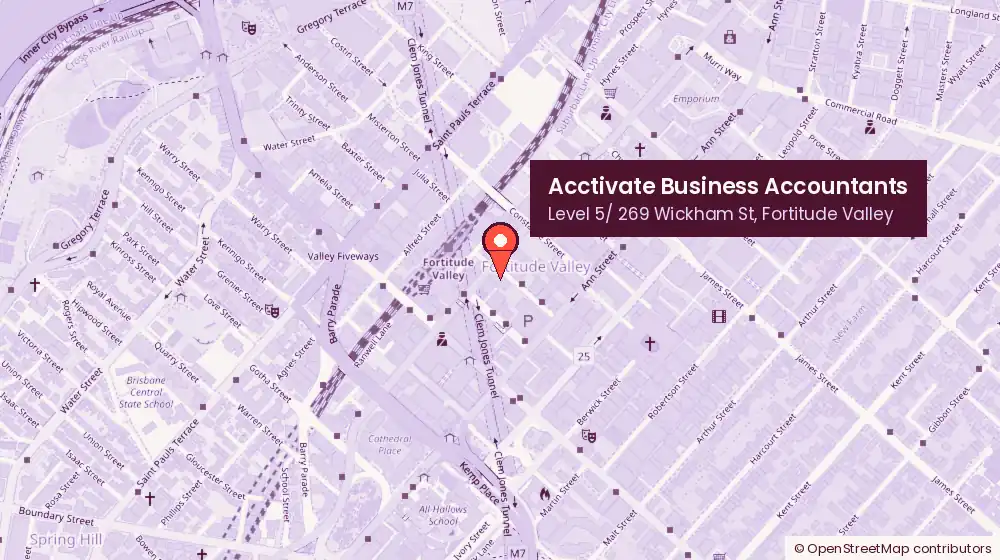
Our office in Fortitude Valley, Brisbane
Level 5/ 269 Wickham St, Fortitude Valley. Monday to Friday, 8:30am to 5pm (Queensland time). Meet us at the office, or online from anywhere in Australia.
Questions tradies ask their accountant
Do you work with my trade?
Very likely. We work with trade businesses across six groups: electrical and energy; plumbing, gas and air; carpentry and structural trades; finishing trades; outdoor and property trades; and metal, mechanical and automotive trades. That covers electricians, solar installers, plumbers, gasfitters, air-conditioning and refrigeration mechanics, carpenters, painters, roofers, tilers, plasterers, landscapers, fencers, welders, mechanics, locksmiths and more. Builders, concreters, formworkers and civil contractors are covered by our construction accountants page.
construction accountants
What does an accountant for tradies do that a general accountant doesn't?
The tax law is the same, but the questions are different. A tradie accountant reads the business by job type, crew and van, costs apprentices against their billable hours, checks charge-out rates against the real cost of each hour, and knows the trade-specific obligations: TPAR, labour-only subbies and super, dual-cab FBT, van stock and licence financial reporting. The aim is numbers you can price and hire from, not only a tax return.
Is my trade business big enough to work with you?
Our ongoing service suits trade businesses turning over $400,000 or more, usually with employees, apprentices or regular subbies, vans on the road and a structure beyond a basic sole trader set-up. If your business is smaller and mainly needs a low-cost annual lodgement, another provider is likely to suit you better. If you’re growing towards that size, it’s worth talking to us before you take on staff or change structure.
who we’re the right fit for
Should I move from sole trader to a company, and when?
It depends on your profit, your risk, who you employ, how you want to take money out and your licence. A company is a separate legal entity, which can help with liability, but it adds costs, lodgements and director obligations, and moving an existing business can carry tax and transfer costs. In Queensland, a new company that contracts for licensed work needs a QBCC licence of its own. We work through the numbers for your business before you change anything.
business structures
How do I work out the right charge-out rate for my business?
Start with the full yearly cost of each tradesperson, including wages, super, leave, workers’ compensation, the van, tools and a share of overheads, then divide it by the hours they actually bill, not the hours they’re paid. Travel, quoting, supplier runs and call-backs usually make the billable figure much lower than owners expect. Add the profit margin on top, and check the rate separately for service, install and project work.
charge-out rates and pricing
What does an apprentice really cost my business?
More than the wage. Add super, leave, workers’ compensation and the supervising tradesperson’s unbilled time, then compare that with the hours the apprentice can bill in each year of the apprenticeship. First-year apprentices usually cost more than they bill; later years often pay back. Award rates change, so the Fair Work Ombudsman’s current pay guides are the reference, and government incentives may apply depending on the occupation.
the real cost of the team
Is my subbie an employee, and do I have to pay their super?
Maybe, even if they have an ABN. The ATO looks at the whole working relationship, such as who controls the work, who supplies the tools and whether they’re paid for hours or results. Separately, if you pay a contractor mainly for their labour, they count as an employee for super guarantee purposes and you may need to pay super for them. Apprentices, trainees, labourers and trade assistants are always employees.
employees, subbies and super
Can I claim my van or ute, and is a dual cab exempt from FBT?
How vehicle costs are claimed depends on who owns the vehicle and your business structure. A dual-cab ute isn’t automatically exempt from fringe benefits tax. The exemption needs an eligible vehicle and private use limited to minor, infrequent and irregular trips, and you still need records. Regular weekend or family use means FBT can apply.
vans, utes and tools
Do I need to lodge a TPAR for my trade business?
If your business mainly provides building and construction services and pays contractors for those services, you’re likely to need to lodge a Taxable Payments Annual Report, due by 28 August each year. Many trades are covered, including electrical, plumbing, air-conditioning, solar, painting, tiling, roofing, landscaping and fencing. The ATO uses a 50% test of income or activity to decide whether your business is mainly in that industry.
GST, BAS and TPAR
Why am I busy and profitable on paper but always short of cash?
Profit is recorded when you do the work; cash arrives when the customer pays. In between, you’ve paid wages, super, suppliers and van finance, and GST and tax may already be due on invoices that haven’t been paid. Slow debtors, materials bought ahead of jobs, owner drawings and quarterly tax payments widen the gap. A rolling 13-week cash forecast shows where the money is going and when a shortfall is coming.
cash flow through a tradie’s year
Can you prepare the financial reports for my QBCC or interstate trade licence?
Yes. We prepare QBCC financial reports and interstate licence reports. In Queensland, self-certifying licensees in categories SC1 and SC2 make a declaration, while higher categories need a report from an independent qualified accountant, and company licensees report every year. Requirements differ between regulators and licences, so we check what your regulator asks for first.
trade licences and financial reporting
Do you work with tradies outside Queensland?
Yes. We work with trade businesses around Australia, mostly through online meetings, from our office in Fortitude Valley, Brisbane. Federal tax, GST and super rules are the same everywhere; licensing, workers’ compensation and payroll tax differ by state, and we check which rules apply to your business. If your crews work across a border, we look at both states.
working with trade businesses around Australia
Which job management software do you work with?
We work in Xero and connect it with job management software such as AroFlo, so jobs, invoices and costs flow into the accounts. Receipts and bills can come in through Dext, and we use Fathom for management reporting. If you use different job software, tell us when we first talk and we’ll look at how it connects to Xero.
job software and reporting
What should I have ready for our first conversation?
Nothing formal. It helps to know your approximate turnover, your business structure, how many people you employ or subcontract, how many vans you run, which software you use, and what’s prompting you to get in touch. If you have recent financial statements or BAS to hand, they help us understand the business sooner, but we can start the conversation without them.
enquire
How much does a tradie accountant cost?
We charge a fixed monthly fee based on the scope of work. The fee depends on how many entities you have, the size of your payroll and apprentice numbers, any licence financial reporting, how often you want reporting and reviews, and how much advisory work is involved. We agree the scope and fee in writing before we start, so there are no surprise bills.
how working together starts
Can I change accountants partway through the year?
Yes. You don’t need to wait until 30 June. Once you engage us, we contact your current accountant for the records and working papers we need, check what’s been lodged and what’s outstanding, and take over from there. Many trade businesses use the change to set up reporting by job type, crew and van at the same time.
changing accountants mid-year
Related services and guides for trade businesses
- Construction accountants for builders and project contractors
- Business accounting and advisory
- Tax planning and compliance
- Structuring and asset protection
- Xero and job software for small businesses
- Accounting for more than one business
- Accounting for trade businesses: a guide
- Setting up Xero for a trade business
- GST, BAS and TPAR for construction and trade businesses
- What a BAS is and how to lodge one
- Choosing a business structure
- How much should I pay myself?
LET'S TALK
Talk through the numbers behind your trade business
Whether you run an electrical, plumbing, air-conditioning, solar, carpentry, painting, roofing, tiling, plastering, bricklaying, landscaping, fencing, glazing, welding or mechanical business, or another trade, and you’re turning over $400,000 or more, tell us what’s prompting you to reach out. We’ll talk through your situation, tell you whether Acctivate is the right fit and explain the next step.
★★★★★5 out of 5 stars
Led by Chartered Accountants Elle Green and Simon Burke.
We review every enquiry and contact you to discuss your business and the support it needs.
We use your details only to respond to your enquiry. Privacy policy
This page is general information only and isn’t advice. It doesn’t take your circumstances into account. Speak with us before acting on it.
ACCTIVATE PTY LTD · ABN 63 677 493 882 · Level 5/ 269 Wickham St, Fortitude Valley · (07) 3185 5303
