
ACCOUNTING FOR ONLINE BUSINESSES
Accountants for Ecommerce and Online Businesses
Ecommerce accountants for established online businesses turning over $400,000+, whether you sell through your own store, marketplaces, subscriptions, stockists, dropshipping, a shopfront and online, or as a creator or digital-product seller. Understand your margins, plan your stock purchases and keep your accounts reliable as the business grows.
Based in Fortitude Valley, Brisbane, working with online businesses around Australia.
★★★★★5 out of 5 stars
Chartered Accountant-led
Elle Green CA and Simon Burke CA, the directors of Acctivate, lead the work for every online business we take on.
Meet the team
Xero set up for online selling
Sales, fees, refunds and GST recorded by channel, so the figures you plan from match your accounts.
Xero and systems
Registered Tax Agent
Tax work for your online business is carried out under the professional obligations of the Tax Agent Services Act.
TASA disclosure statement
Accounting Consultant of the Year 2025
Elle Green won Accounting Consultant of the Year at the Women in Finance Awards 2025.
See the 2025 results
Meet Elle
YOUR STORE IS GROWING. WHAT ARE YOU KEEPING?
Ecommerce accounting services for online businesses
An online store pays for stock months before it sells and for ads before the orders arrive, then receives its sales as payouts with fees and refunds already taken out. Our ecommerce accountants connect those realities with the numbers you use to price, reorder, hire and plan.
Margin reporting by product and sales channel
See margin after fees, postage, returns and ad spend, not just price less product cost.
Margin by product and channel
Landed cost, slow lines and stock held by 3PLs
Track landed cost, slow lines and stock held by a 3PL, so the next order fits the cash you have.
Stock and landed cost
GST and BAS across every sales channel
Your store, marketplaces, overseas customers and imported stock each raise their own GST questions.
GST and BAS for ecommerce
From side hustle to first employee and 3PL
Know what arrives with the first employee, the first 3PL and the second channel.
What changes as you grow
EVERY WAY YOU SELL
Accountants for Shopify stores, Amazon sellers and creators
The tax rules are the same for every online business; the economics are not. Clothing, beauty, homewares, pet and gift products are typical, but the way you sell matters more than the category.
Shopify, WooCommerce and other own-store brands
Brands selling through their own store on Shopify, WooCommerce or another platform. Every order carries payment fees, apps, postage and packaging, and the payout is net of fees and refunds.
Amazon, eBay and Etsy marketplace sellers
Businesses selling on Amazon, including through Fulfilment by Amazon, eBay, Etsy and other marketplaces, alone or alongside their own store. Marketplace fees and ads, settlement reports and stock held in a fulfilment centre all change what a sale is worth.
Direct-to-consumer and subscription brands
Brands that sell straight to customers, including subscription boxes and memberships. Ad spend is paid months before repeat orders pay it back, and prepaid subscriptions bring in cash before goods are delivered.
Wholesale and online brands, and importers
Brands selling to stockists as well as through their own store, often importing their range. Wholesale sells lower, on payment terms; imported stock adds deposits, freight, duty and currency to every purchase.
Dropshipping and print-on-demand
Businesses where a supplier holds the stock and ships the order, at a turnover of $400,000+. There is little stock to fund, but refunds, chargebacks, supplier reliability and where the goods ship from all affect margin and GST.
Shopfront retailers and multi-brand online sellers
Retailers with a physical shop and an online store selling from one pool of stock, and owners running more than one store or brand. Shared stock, staff and overheads have to be split fairly before anyone can see which store pays its way.
Content creators and digital-product sellers
Content creators, and businesses selling courses, templates, downloads or memberships. Income arrives as platform payments, subscriptions, sponsorships, affiliate commissions, tips and products received for promotion, often from overseas.
Selling online some other way? Tell us about your business through the form. If you make your own products and your main questions are about production costs, see our manufacturing accountants page.
Accounting for established ecommerce and online businesses
You’re likely to be a good fit if most of these describe your business:
- Any of the ways of selling online above, including creator and digital-product income
- Annual turnover of $400,000+
- Stock to fund, ad spend to manage, or more than one sales channel
- Employees, contractors, a 3PL or an agency doing work for the business
- A company, a trust or more than one entity, or you’re about to need one
- Xero in use, or a plan to move to it
- You want to talk through the numbers during the year, not only when the tax return is due
- Based anywhere in Australia
When your online business needs a different specialist
Our ongoing service is likely to be the wrong kind of help if:
- You’re selling online as a side hustle turning over less than $400,000 and the priority is the lowest-cost lodgement.
- You need only an individual tax return. A tax agent who prepares individual returns will suit you better.
- You manufacture your own products and the main questions are production costing and raw materials. Our manufacturing accountants page covers that work.
- You need tax advice in another country where you sell or hold stock (a specialist in that country), customs clearance (a licensed customs broker), trademark, contract or consumer-law help (a lawyer), or finance (a finance broker).
Online brands and ecommerce businesses we work with
Scrub Haus, an Australian brand of nursing scrubs and medical uniforms, and TB Meals, which sells ready-made meals online for delivery across Brisbane and the Sunshine Coast, are two of the online businesses we work with. Their owners’ reviews are below.
Read their reviews


When to speak to an ecommerce accountant
Most owners don’t arrive with a neat accounting question. They arrive with one of these.
| What you’re noticing | What needs looking at | Where this page covers it |
|---|---|---|
| Sales are up, but the bank balance isn’t | Stock bought ahead, ad spend, payout timing, tax set aside | Cash flow forecasting for ecommerce businesses |
| Shopify says one sales figure, the bank another, and Xero a third | Payouts recorded net instead of split into sales, fees, refunds and GST | Xero for ecommerce with Shopify, Amazon and marketplaces |
| A Shopify brand starting on Amazon, or ad spend climbing without knowing whether it pays | Contribution margin per order in each channel | Ecommerce profitability by product, channel and ad spend |
| A large peak-season stock order, or old stock to write down | Landed cost, the cash tied up and year-end stock value | Ecommerce inventory accounting and landed cost |
| First orders from overseas customers, or first stock imported directly | GST-free export conditions, GST at the border, currency | GST and BAS for online sellers and marketplaces |
| A subscription brand taking prepaid orders, or gift cards selling well | When GST is reported, and cash received before goods are delivered | GST and BAS for online sellers and marketplaces |
| Moving from sole trader to a company, or adding a second brand | Liability, tax, admin and one combined view | Business structures and multiple entities for online businesses |
| First employee, a contractor or virtual assistant, or a 3PL | Employee or contractor, super, PAYG withholding, Single Touch Payroll | Staff, contractor and 3PL costs for ecommerce businesses |
AS THE BUSINESS GROWS
Ecommerce business accounting from side hustle to multi-brand
Most online businesses have grown faster than their set-up. Each stage brings new obligations and numbers to watch; the examples are illustrations.
Accounting for a solo online seller
Picture someone selling homewares on Etsy and through their own small store, alongside another job. Sales made online are business income, and the ATO runs an online selling data-matching program that compares marketplace sales data with what sellers declare. A business must register for GST once its GST turnover reaches $75,000, and overseas sales count towards that turnover even though they are GST-free.
Registering for GST and holding trading stock
Once the business holds real stock, the BAS rhythm and year-end stock value start to matter. An increase in the value of trading stock over the year is assessable income, so a business that has built up stock can owe tax on profit sitting on the shelves rather than in the bank.
First employees, a 3PL and a second channel
A direct-to-consumer brand that hires a customer service employee and hands fulfilment to a 3PL becomes an employer. Employers register for PAYG withholding before the first payment that needs it, report payroll through Single Touch Payroll, pay super guarantee for eligible workers and hold workers’ compensation insurance under their state or territory scheme. From 1 July 2026, under Payday Super, super guarantee has to reach the employee’s fund within 7 business days of payday, with longer in some situations.
Several brands, entities or overseas markets
A group running two brands through separate entities, importing and exporting, needs each entity’s records and lodgements kept separately and the group read as one. Payroll tax becomes a question as total wages approach the threshold, and loans between related entities need planning before year end.
Business structures and multiple entities for online businesses
An online business carries real commitments: supplier orders paid in advance, stock, leases, and claims if a product causes harm. Structure is one way owners manage that exposure, alongside insurance. It also decides how profit is taxed, how a co-founder or investor comes in, and the admin load. The right structure depends on your circumstances.
Sole trader, company or trust for online sellers
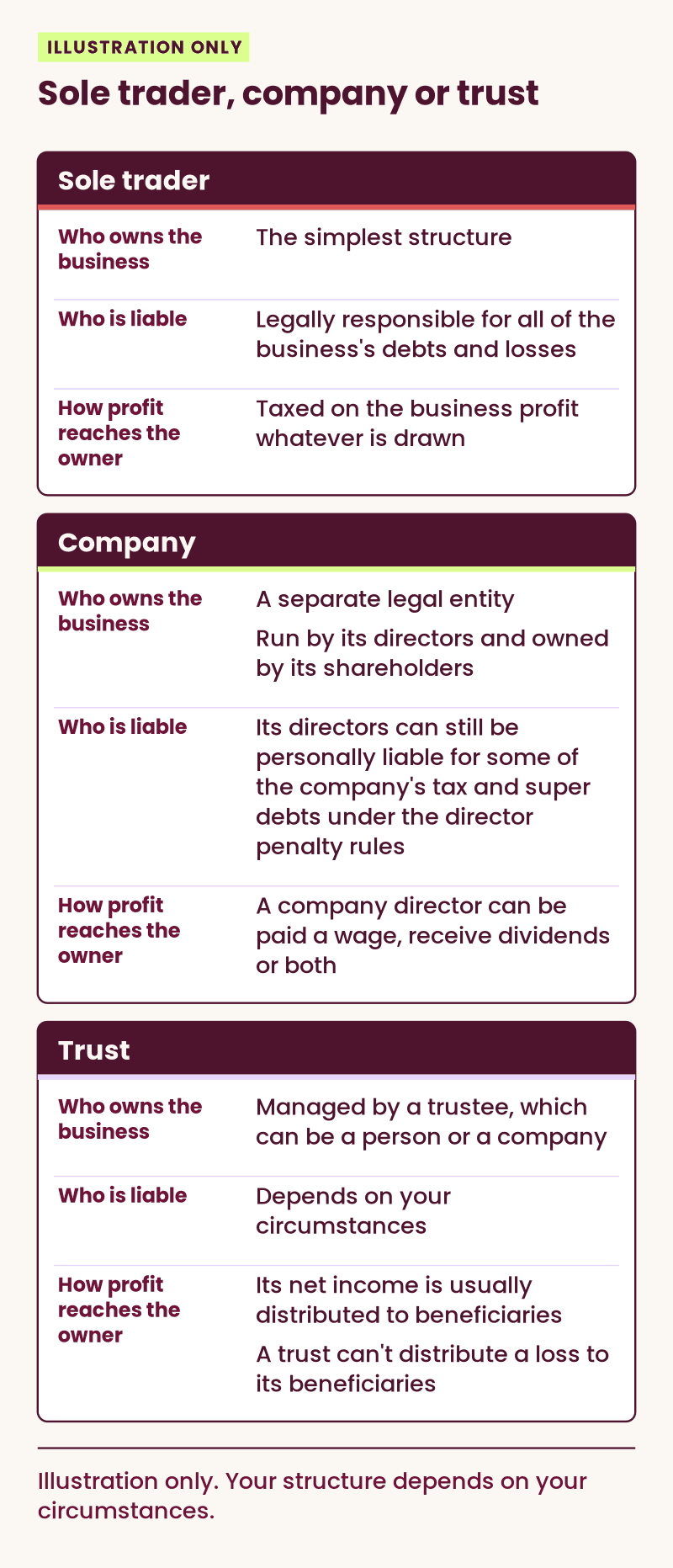
A sole trader is the simplest structure and is legally responsible for all of the business’s debts and losses. A company is a separate legal entity with its own tax and super obligations, run by its directors and owned by its shareholders; its directors can still be personally liable for some of the company’s tax and super debts under the director penalty rules. A trust is managed by a trustee, which can be a person or a company, and its net income is usually distributed to beneficiaries; a trust can’t distribute a loss to its beneficiaries. When a private company lends money to its shareholders or their associates, Division 7A can treat the loan as a deemed dividend unless it is repaid, or put on a complying loan agreement, before the company’s tax return is due or lodged.
Running more than one online store or brand
A founder who launches a second brand, or buys an existing online store, ends up with two sets of records, shared stock, staff and overheads, and money moving between the businesses. Each entity needs accurate accounts, and the owners need one combined view that doesn’t double count what one business charges the other.
MARGIN
Ecommerce profitability by product, channel and ad spend
Most margin problems in online businesses come from judging every sale on its gross margin, and from treating very different channels as if they earned the same.
Contribution margin per order: a worked example
The sale price has to cover far more than the product: platform or marketplace fees, payment fees, pick, pack and delivery, packaging, returns and refunds, discounts, and the advertising that won the order. Gross margin is the sale price less the product’s landed cost. Contribution margin is what’s left after every per-order cost, and it has to pay for the team, software and office, and leave a profit.
Illustration only. All figures are assumptions chosen to show the method, not platform fee rates or industry benchmarks. Figures exclude GST.
| Item | Amount | Left after this cost |
|---|---|---|
| Revenue, excluding GST | $100 | $100 |
| Landed product cost | −$38 | $62 (gross margin) |
| Payment and marketplace fees | −$4 | $58 |
| Fulfilment and delivery | −$12 | $46 |
| Advertising attributed to the order | −$30 | $16 |
| Contribution before overheads and tax | $16 |
- A 62% gross margin becomes a 16% contribution once the costs of selling and delivering are counted.
- If the advertising attributed to this order rises to $40, the contribution falls to $6. Above $46, the order loses money before a single overhead is paid.
- Your own figures will differ. The method is what carries across.
Shopify, Amazon and wholesale margins compared
Take a skincare brand selling through its Shopify store, on Amazon and to stockists. The store order carries ad spend and postage but is paid upfront; the marketplace order carries a larger fee and fulfilment charges; the wholesale order sells lower, on payment terms, without ads or postage. In one sales line, nobody can see which channel carries the others, so reporting by channel is usually the first change worth making. Returns belong in the same view: a refunded order can lose the sale, the payment fee, the freight both ways and the handling, and sometimes the stock itself.
Advertising profitability: ROAS against contribution and cash
Return on ad spend shows the revenue each advertising dollar brought in, but revenue isn’t profit, and ads are paid for before the orders turn into cash. Ad spend is better judged against contribution margin per order and, for brands built on repeat customers, against a customer’s value over several orders.
Staff, contractor and 3PL costs for ecommerce businesses
As an online business grows, more of its costs sit with people and providers: customer service, packing, content, ads and fulfilment. The tax and super rules follow the real working relationship, not what the paperwork calls it.
In-house fulfilment versus a 3PL, per order
Packing in-house means rent and wages whatever the week’s orders. A 3PL turns much of that into a cost per order plus storage and receiving charges, so the comparison is per order, at the volumes you expect, including peak season.
Employee or contractor rules for VAs and agencies
The ATO looks at the whole working relationship to decide whether a worker is an employee or an independent contractor. For super, a contractor paid mainly for their own labour is treated as an employee, and having an ABN makes no difference. Contracting a company, trust or partnership to achieve a result is different. Award and employment-law questions are a matter for a workplace-relations adviser.
Payday Super and payroll tax for growing online businesses
Under Payday Super, from 1 July 2026, the 7 business day timeframe for super guarantee contributions also applies to contractors paid mainly for their labour, so super goes out with every pay cycle. Payroll tax is charged by the state or territory where your workers are, once total Australian wages pass its threshold; thresholds and rates differ, and some contractor payments can count.
Ecommerce inventory accounting and landed cost
Stock is one of the largest uses of cash in an online product business, and easy to lose track of across a warehouse, a 3PL and an Amazon fulfilment centre.
What belongs in landed cost under AASB 102
The supplier’s price is only part of what a unit costs. Under AASB 102, the accounting standard for inventories, the cost of stock includes the purchase price, import duties, transport, handling and other costs of getting it to its present location and condition; selling costs, and storage costs that aren’t part of a production process, are expensed when incurred. So advertising, payment fees and ordinary warehousing show up in the reports as costs of selling, not in the stock value. For tax, the ATO’s cost price method similarly includes freight, insurance, customs duty and delivery, and GST is generally left out if you’re entitled to GST credits.
Year-end stocktake and trading stock valuation
Under the general trading stock rules, the business does a stocktake as close as possible to the end of the income year and values each item at cost, market selling value or replacement value; the method can differ between items and years. An increase in the value of stock over the year is assessable income, and a decrease is a deduction. Eligible businesses with an aggregated turnover under $50 million can use simplified rules instead if they reasonably estimate that their stock value changed by $5,000 or less over the year, with no formal stocktake. Stock held by a 3PL or a marketplace is easy to miss in a count.
Slow-moving stock and stock taken for private use
Damaged, obsolete or slow lines that only sell at a clearance price tie up cash, and can overstate profit if they stay in the accounts at cost; the market selling value method can give them a lower value. Stock the owners take for their own use is treated as if sold, and its value is included in assessable income; the ATO expects a record of the date, item, reason and value.
GST and BAS for online sellers and marketplaces
GST on own-store and marketplace sales
When stock is already in Australia at the time of sale, the business selling it accounts for the GST, whether the order comes through its own store or a marketplace such as Amazon or eBay. The ATO’s rules that make a marketplace operator responsible for GST apply mainly to low value imported goods and digital products sold into Australia by overseas businesses.
GST-free exports to overseas customers
Goods exported from Australia are generally GST-free if they leave within 60 days of the business receiving any payment or issuing an invoice, whichever comes first; if they aren’t exported, the sale can become taxable and an adjustment is needed. A sale of digital products or content can be GST-free when the customer is outside Australia, but only if the business knows where each customer is. Tax obligations in the countries you sell into are a matter for a specialist there; our work covers the Australian accounts, tax and GST.
GST on imported stock and foreign currency payments
GST is payable on most imported goods, generally before they’re released, on a value that includes the customs value, any customs duty, and transport and insurance to Australia. A GST-registered business importing for its business can usually claim that GST as a credit. Under the deferred GST scheme, eligible importers pay the GST through their monthly BAS instead of at the border; eligibility includes an ABN, GST registration and lodging the BAS monthly online. Customs duty is still payable before release. Amounts in foreign currency are translated into Australian dollars for tax, and a rate movement between ordering and paying can create a foreign exchange gain or loss.
GST timing for refunds, gift cards and pre-orders
When a customer returns goods and is refunded for a sale already reported in an earlier BAS, the GST is corrected through a decreasing adjustment, generally in the BAS for the period you become aware of it, once the customer has been reimbursed. GST on a gift card that can be spent across your range is generally accounted for when it’s redeemed, not when it’s sold. Businesses with an aggregated turnover under $10 million can choose to account for GST on a cash basis, reporting it when payment is received, or on a non-cash basis, reporting it when the invoice is issued or payment is received, whichever comes first. For pre-orders, prepaid subscriptions or wholesale terms, the choice changes when GST is paid.
how BAS works
CASH FLOW
Cash flow forecasting for ecommerce businesses
An online business can be profitable on paper and still short of cash, because money goes out months ahead of the sales. Stock for Black Friday, Christmas and end-of-financial-year sales is paid for well before it sells, ad spend goes out before the orders come in, and some marketplaces hold back part of each payout. GST, PAYG withholding, super and tax set aside are money that isn’t yours to spend.
Cash flow planning for peak-season stock orders
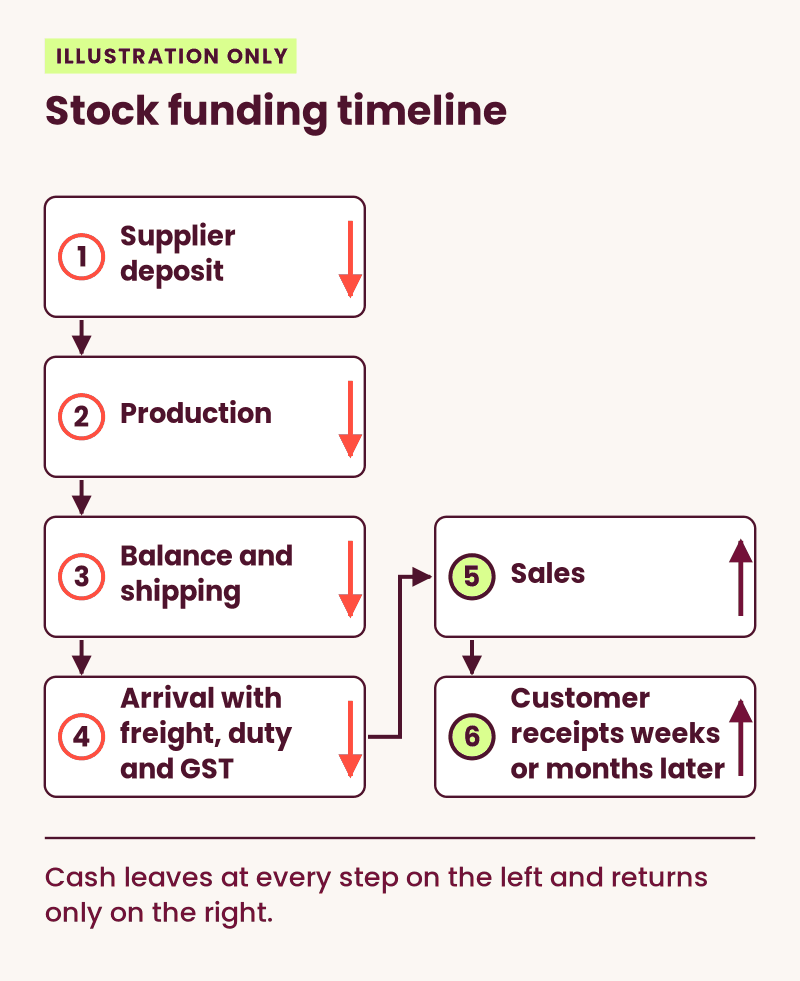
A brand ordering peak-season stock often pays a deposit on order, the balance before shipping, then freight, duty and GST when it lands, all before the first sale. The question is whether cash, expected payouts and any finance cover the order until the stock sells through and customers have paid. If not, the order is resized or split before it’s placed.
A rolling 13-week cash flow forecast
A rolling 13-week cash forecast lists what’s due in from payouts, wholesale customers and subscriptions, and what goes out: stock and freight, ad spend, wages and super, 3PL invoices, BAS and PAYG instalments. Updated weekly, it shows a shortfall while there’s still time to act.
Managing ATO debt when stock or ad spend squeezes cash
A slow-selling stock order or a season of ad spend that didn’t pay back can leave a sound business unable to pay its BAS or super on time. The priorities are lodging on time even when you can’t pay in full, and talking to the ATO early. The ATO may agree to a payment plan, but that’s the ATO’s decision, and the general interest charge applies to any amount unpaid by the due date.
Tax planning and owner pay for online businesses
Most tax surprises in online businesses come from a strong year nobody forecast, or from profit tied up in stock.
Year-end tax planning before 30 June
Planning starts with a forecast of the year’s profit, built from the accounts to date and the sales expected. A stock order placed before 30 June is often less useful for tax than owners expect, because stock still on hand at year end is counted in closing stock. The instant asset write-off can bring forward a deduction for equipment, but a purchase made only for the deduction leaves less cash. PAYG instalments are regular prepayments of the tax on business and investment income and can be varied, so a forecast shows whether they are running too high or too low before the bill arrives.
tax planning
Paying yourself and planning an ecommerce exit
How you take money out depends on your structure. A sole trader is taxed on the business profit whatever is drawn. A company director can be paid a wage, receive dividends or both, and money taken out any other way can become a Division 7A loan. Trust distributions follow the trust deed and the trustee’s decisions. If a sale of the business is possible, clean accounts by channel and product and reliable stock records matter to a buyer.
paying yourself
Xero for ecommerce with Shopify, Amazon and marketplaces
Shopify payouts versus your sales and profit
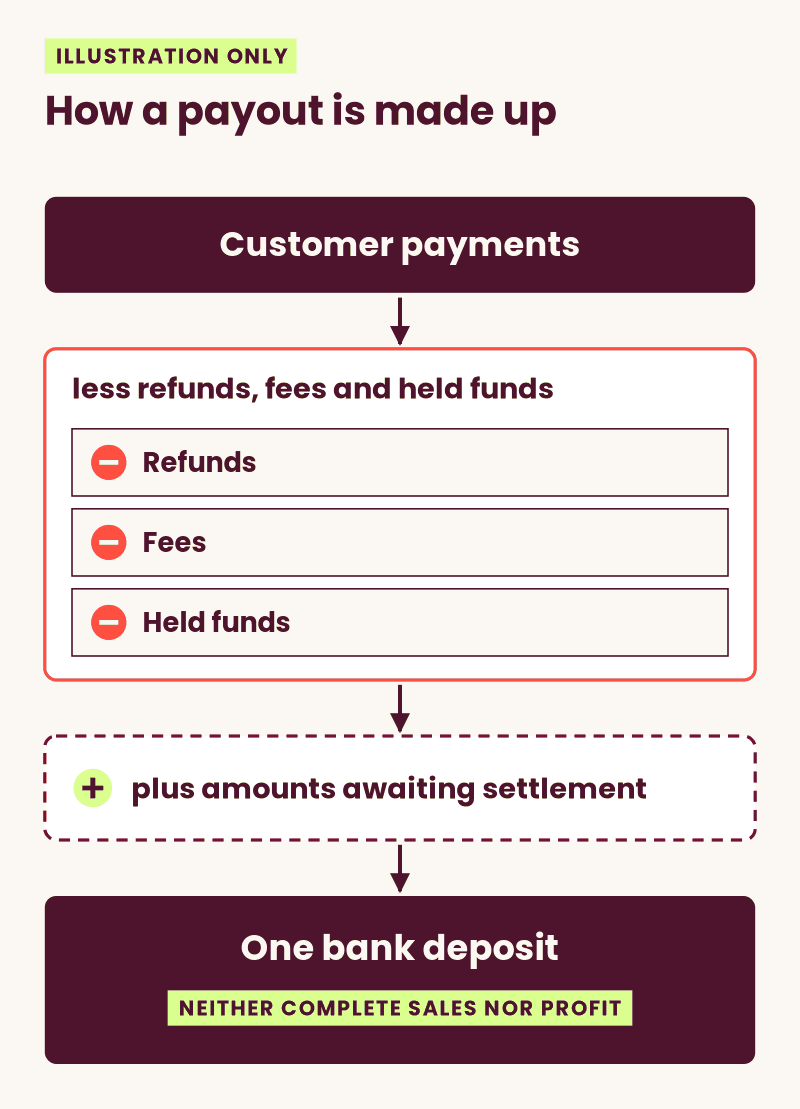
Stores, marketplaces and payment providers pay out a net amount: customer payments less refunds, fees and any funds held back, with some sales still waiting to settle. Shopify itself says its Shopify Payments activity report isn’t a statement of revenue for accounting purposes, and that a payout can change because of refunds, chargebacks, reserves and adjustments. Recorded as one deposit, a payout understates sales, hides the fees and can put the wrong GST on the BAS.
Connecting Shopify, Amazon and payment providers to Xero
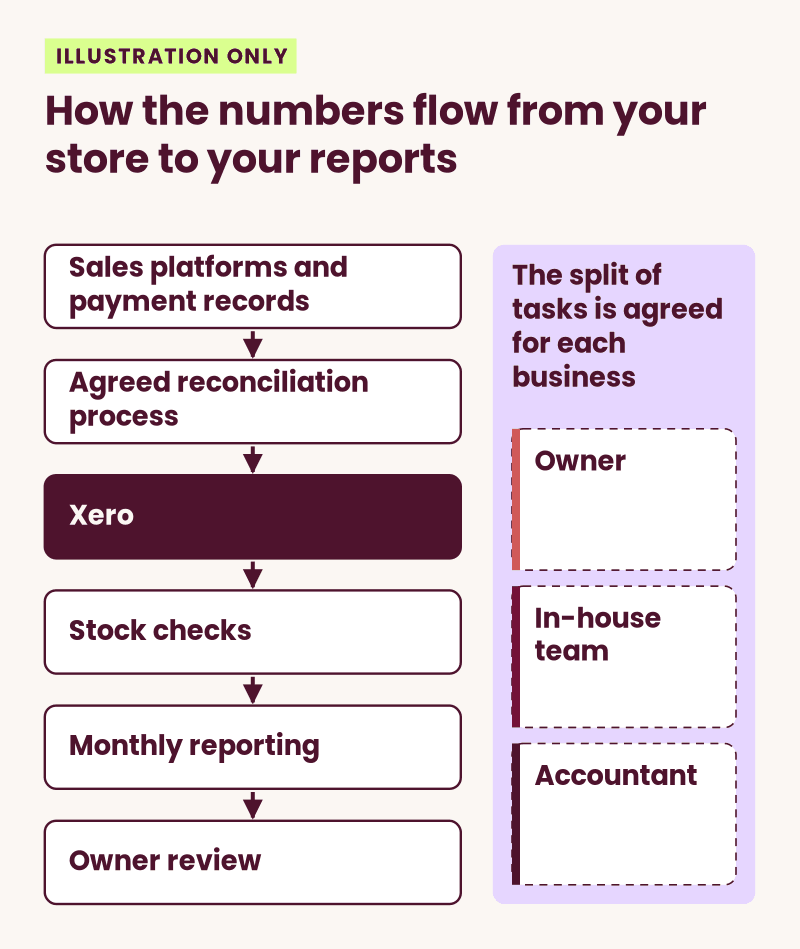
We set up Xero so each payout from Shopify, WooCommerce, Amazon, eBay or your payment provider is split into gross sales, refunds, fees and GST, tracked by channel and, where it helps, by brand. The connector chosen for the business depends on its channels; we check how it’s configured, how stock records reconcile, and who does what. At the start we agree which tasks sit with the owner, which with your in-house team and which with us, so nothing is done twice or missed.
Xero and systems
Monthly management reports for ecommerce businesses
| Report | The decision it supports |
|---|---|
| Contribution margin by channel, with Shopify, Amazon and wholesale shown separately | Where to put the next dollar of ad spend and effort |
| Margin by product or product line | What to reorder, reprice or drop |
| Stock on hand, stock turn and aged stock | The size and timing of the next order, and what to clear |
| Ad spend against contribution margin per order | Whether growth is paying for itself |
| Refunds, returns and chargebacks by product and channel | Product, listing or supplier problems worth fixing |
| Cash forecast for the next 13 weeks | Timing of stock orders, tax payments and finance |
| Tax set aside against tax owing | Avoiding a shortfall at BAS and year end |
Talk to an ecommerce accountant about your margins
Tell us how the business sells today, and we’ll show you what we’d look at first.
CLIENT FEEDBACK
Acctivate reviews from ecommerce and business owners
5.0 from 200+ Google reviews. The first two are from owners of online businesses we work with; the others are from business owners across industries. All are quoted as written; Kassi-Lee Feeney’s is an excerpt.
SUPPORT WHILE GROWING
★★★★★5 out of 5 stars
As a new founder, I’ve definitely had my 101 questions along the way and they’ve always been so helpful and supportive. Ale, my Client Manager is incredible! Always so prompt with her replies and happy to help with whatever I throw her way. Simon and the whole team have also been amazing to deal with! So grateful to have such a great team behind me while I navigate growing Scrub Haus!
Kassi-Lee Feeney, Scrub Haus
Google review (excerpt)
WEEKLY CHECK-INS
★★★★★5 out of 5 stars
I have had my fair share of accounts over half a decade for my business and have never found the right fit. Simon and the team at activate business accountants are the only team I have genuinely trusted when it comes to the back end of the accounting side. The weekly check ins and thorough breakdown on whats going on in my business when it comes to finances, is something I needed and appreciated. Do yourself a favour and get yourself a good accountant! This is the team you want on your side. Business isnt easy, and it pays dividends to have the right team behind you.
Matt Fitzgerald, Owner, TB Meals
Google review
XERO, PROFIT AND SALES FIGURES
★★★★★5 out of 5 stars
I met with Simon from Acctivate to review my accounting practices for my business. The session was incredibly insightful and productive. Simon gave me three key things that I could immediately review and update. Since then, I’ve implemented new practices for how I use Xero, how I manage profitability, and the way I look at my sales figures and pipeline. That one session alone has helped me get so much more clarity and confidence leading into 2026! A massive thank you to Simon. I feel like I’ve got a great supporter in my corner!
Kristy Hunter
Google review
TAX ADVICE AND PROFIT PROJECTIONS
★★★★★5 out of 5 stars
As a small business owner, having a great accountant is must! Since signing up with Acctivate we feel we can focus more on our passion and thrive, while Elle and Simon look after us. working closely with us giving tax advice, profit projections, general help with Xero and much more! They are always happy to pick up the phone and answer any questions and help where they can. We look forward to continue working closely with Acctivate and growing our businesses together.
Noam
Google review
SWITCHING ACCOUNTANTS
★★★★★5 out of 5 stars
The team at Acctivate are friendly and approachable. We made the switch from a big firm. We wanted a better relationship with our accountants and it was a breeze. Couldn’t be happier.
Zac Keune
Google review
INFORMED DECISIONS
★★★★★5 out of 5 stars
Simon and the team at Acctivate deliver insights that helps us make informed decisions. They communicate clearly and we know what to expect of them at every engagement.
Samuel Longfield
Google review
Meet the accountants behind your ecommerce advice
The people who look at your numbers are the people you speak to.

Elle Green CA
Director and Co-Founder
Elle is a Chartered Accountant and Registered Tax Agent who specialises in small business taxation and cash flow management. She won Accounting Consultant of the Year at the Women in Finance Awards 2025.
Meet Elle

Simon Burke CA
Director and Co-Founder
Simon is a Chartered Accountant working across accounting and business advisory. He helps owners build strong foundations through better cash flow, sound structures and practical efficiency, which matters most when an online business has outgrown the set-up it started with.
Meet Simon

Chloe Sullings CPA
Business Specialist
Chloe is a CPA whose experience runs from boutique practices to top 100 firms. She breaks complex accounting information down so owners understand it and know which questions it raises for the business.
Meet the team
Why ecommerce business owners choose Acctivate
Chartered Accountants you deal with directly
Elle Green CA and Simon Burke CA lead the work. You speak with the people who know your accounts, not a different person every call.
Reports that separate sales, payouts and stock
Reporting is set up around how your online business earns money, so you can see which products, channels and brands are paying their way.
business accounting and advisory
Cash checked against upcoming stock orders
Reviews look at the cash needed for upcoming stock orders and commitments, and you can talk the numbers through before a major order or expansion, not after it.
A written scope before the work starts
What we’ll do, how often we’ll report and who handles reconciliation, reporting and tax are agreed in writing before we begin.
How to switch accountants for your online business
Five steps from first conversation to monthly reporting
- Understand: a conversation about how you sell, your team, your entities and what’s prompting you to get in touch.
- Review: we look at your recent accounts, lodgements, Xero file and channel reports to see where things stand.
- Agree the scope: a written scope covering compliance, reporting and advisory, and who handles which tasks, agreed before the work starts.
- Set up: we take over from your current accountant and set up reporting by channel, product and, where relevant, brand.
- Review and act: regular reviews of the numbers with you, and the tax and planning work through the year.
What shapes the scope of your ecommerce accounting
The work depends on how many entities and brands you run, how many channels feed Xero, how much stock you carry and where, the payroll, whether you import or export, and how often you want reporting and reviews.
Changing accountants mid-year
You don’t have to wait until 30 June. When you engage us, we contact your current accountant for the records and working papers we need, check what has been lodged and what is outstanding, and pick up from there.
Brisbane ecommerce accountants for online sellers across Australia
We work with online businesses around Australia from our Brisbane office, mostly through online meetings and shared access to Xero. Income tax, GST and super are federal and the same everywhere; payroll tax and workers’ compensation change at the border, and we check which state’s rules apply when we scope the work. Clients in Sydney, Melbourne, Perth, Adelaide, Canberra, Hobart, Darwin and the Gold Coast work with us the same way.
Our office in Fortitude Valley, Brisbane
Level 5/ 269 Wickham St, Fortitude Valley. Monday to Friday, 8:30am to 5pm (Queensland time). Meet us at the office, or online from anywhere in Australia.
Ecommerce and online business accounting FAQs
Do you work with my kind of online business?
Very likely. We work with own-store brands, Amazon and other marketplace sellers, subscription brands, wholesale brands also selling online, importers, dropshippers, shopfront retailers, owners of several stores or brands, and creators and digital-product sellers, turning over $400,000 or more.
every way you sell
Do I need an ecommerce accountant if I already use Xero?
Xero holds the numbers; it doesn’t decide how payouts are split, how stock is valued, which channel earns what or what the next stock order does to cash. An ecommerce accountant sets those up, checks them, and uses the results with you for pricing, purchasing, GST and tax decisions.
Xero for ecommerce
Is my online business big enough to work with you?
Our ongoing service suits online businesses turning over $400,000 or more, usually with stock or ad spend to manage, more than one channel, staff, contractors or a 3PL, and more than a basic sole trader set-up.
who we’re the right fit for
Why are my Shopify sales different from my bank deposits?
A payout is customer payments less refunds, fees and any funds held back, and some sales are still waiting to settle. Shopify says its own payments activity report isn’t a statement of revenue for accounting purposes. Recording each payout as sales therefore understates sales and fees and can put the wrong GST on the BAS.
why a payout isn’t your sales
How do I know if I'm profitable after advertising?
Work out the contribution of an order: revenue less landed product cost, fees, fulfilment and the advertising attributed to it. If the contribution is thin or negative in a channel, growth there costs money. Return on ad spend alone can’t show that, because it measures revenue, not what’s left.
margin by product and channel
How do stock purchases show up in my accounts?
Stock you buy isn’t all an expense straight away. What’s still on hand at year end is counted and valued at cost, market selling value or replacement value, and an increase in stock value over the year is assessable income. That’s why a business can show a profit while its cash is sitting in the warehouse.
stock and landed cost
How do I plan cash for the next stock order?
Map the order’s payments, from deposit to balance to freight, duty and GST on arrival, against the payouts and customer receipts expected over the same weeks. A rolling 13-week forecast shows whether the cash holds until the stock sells through, while there’s still time to resize the order or arrange finance.
planning the next stock order
Can you report Shopify, Amazon and wholesale separately?
Yes. We set up Xero to track sales, fees, refunds and GST by channel and, where it helps, by brand, so contribution margin can be compared between your store, each marketplace and wholesale.
monthly reporting
How do refunds and chargebacks affect the accounts and BAS?
A refund can cost the sale, the payment fee, freight both ways and handling, so it belongs in margin reporting. When you refund a sale reported in an earlier BAS, you make a decreasing GST adjustment, generally in the BAS for the period you become aware of it, after the customer has been reimbursed.
refunds and GST
We import stock and sell overseas. What do you cover?
We cover the Australian side: GST on imports, the deferred GST scheme, GST-free exports, currency gains and losses, and the Australian accounts and tax. Exported goods are generally GST-free if they leave within 60 days of payment or invoice. Tax registrations or returns in other countries need a specialist there.
importing and overseas sales
Who accounts for GST when I sell through a marketplace?
If your stock is already in Australia when it sells, you account for the GST on the sale, whether it comes through your own store or a marketplace such as Amazon. The rules that make a marketplace operator responsible for GST apply mainly to low value imported goods and digital products sold into Australia by overseas businesses.
GST and BAS for ecommerce
Can you review our existing Xero and store set-up?
Yes. We look at how payouts, fees, refunds and GST are being recorded, how the store and marketplace connections are configured, how stock is valued and whether the reports answer the questions you’re asking. Reviewing and optimising existing systems sits under our Software for SMEs service.
Xero and systems
Can you work alongside our existing team?
Yes. Many online businesses have someone in-house handling orders, supplier bills or payroll. We agree at the start which tasks sit with the owner, which with your in-house team and which with us, covering reconciliation, reporting, BAS and tax, so nothing is done twice or missed.
how working together starts
I'm a content creator. What counts as income?
More than what reaches your bank account. The ATO lists advertising and platform payments, sponsorships and affiliate links, tips, donations and subscriptions, and free products or experiences received for promotion, which generally need to be declared at market value. The ATO also data-matches with platforms.
creators and digital products
Can we work with you from another state?
Yes. We work with online businesses around Australia, mostly through online meetings, from our office in Fortitude Valley, Brisbane. Payroll tax and workers’ compensation differ by state and territory, and we check which rules apply to you.
working with ecommerce businesses around Australia
Can I change accountants partway through the year?
Yes, you don’t need to wait until 30 June. We contact your current accountant for the records we need, check what’s been lodged and what’s outstanding, and take over from there.
changing accountants mid-year
Ecommerce accounting services and resources
- Business accounting and advisory
- Tax planning and compliance
- Structuring and asset protection
- Xero and systems for small businesses
- Accounting for more than one business
- Accountants for growing businesses
- Manufacturing accountants
- Choosing a business structure
- What a BAS is and how to lodge one
- How much should I pay myself?
- Seven steps to improve cash flow
LET'S TALK
Request an ecommerce accounting consultation
Whether you sell through your own store, marketplaces, subscriptions, stockists, dropshipping, a shopfront or as a creator or digital-product seller, and you turn over $400,000 or more, tell us what’s prompting you to reach out. We’ll talk through your situation, tell you whether Acctivate is the right fit and explain the next step.
★★★★★5 out of 5 stars
Led by Chartered Accountants Elle Green and Simon Burke.
We review every enquiry and contact you to discuss your business and the support it needs.
We use your details only to respond to your enquiry. Privacy policy
This page is general information only and isn’t advice. It doesn’t take your circumstances into account. Speak with us before acting on it.
ACCTIVATE PTY LTD · ABN 63 677 493 882 · Level 5/ 269 Wickham St, Fortitude Valley · (07) 3185 5303
