
BREAK-EVEN CALCULATOR
Business Break-Even Calculator
See the sales and units your business needs each month to cover its costs, how far above that line you are, and what a price or cost change would do. GST is handled for you.
- Break-even sales, ex and including GST
- Margin of safety and profit at your expected sales
- Price and cost what-ifs side by side
For Australian businesses of any size. Results show as you type. No sign-up.
From Acctivate Business Accountants, led by Chartered Accountants Elle Green and Simon Burke. Registered Tax Agent.
Break-even calculator: enter your figures
Use monthly figures. Sell many products? Use your average sale and its average variable cost. Results update as you type.
Your break-even
Add your price, variable cost and fixed costs to see your break-even.
Break-even sales a month
–
– including GST · – units
Your expected sales are % above break-even.
Your expected sales are % below break-even.
Price doesn't cover the variable cost, so there's no break-even point.
Add expected units to see your margin of safety.
Contribution per unit
– (–)
Price less variable cost. Shown with the contribution margin.
Margin of safety
– (–)
How far sales can fall before the business makes a loss.
Profit at your expected sales
– a month · – a year
Sales for your target profit
– units · – excluding GST · – including GST
Break-even sales a year
–
Price used, excluding GST
–
Not included: income tax, GST-free sales, costs that step up with volume, and differences in margin between products.
What if prices or costs change
Each row changes one figure and keeps the rest as entered.
| Scenario | Break-even units | Break-even sales ex GST | Profit a month |
|---|---|---|---|
| Your figures | – | – | – |
| Price down 10% | – | – | – |
| Price down 5% | – | – | – |
| Price up 5% | – | – | – |
| Price up 10% | – | – | – |
| Variable costs up 10% | – | – | – |
| Fixed costs up 10% | – | – | – |
| Sales volume down 10% | – | – | – |
Discuss your figures
Your break-even is above. Want an accountant to look over your pricing and costs with you? It’s optional.
We use your details only to respond. Nothing is stored unless you send it. Privacy policy
How to read your break-even
Contribution per unit
What each sale leaves after its variable cost. It’s the amount that pays the fixed costs, then becomes profit.
Break-even sales and units
Fixed costs divided by the contribution per unit gives the units. Fixed costs divided by the contribution margin gives the sales. Units are rounded up to whole units.
Margin of safety
The gap between your expected sales and break-even, in dollars and as a share of expected sales. A negative figure means sales sit below break-even.
Target profit
Add the profit you want to the fixed costs and divide by the contribution again. The result is the sales needed for that profit, before tax.
Results are excluding GST unless marked. Sales including GST assume every sale is taxable. Fixed costs stay fixed and the variable cost per unit stays the same at every volume.
Where each figure comes from
| Figure | What it means | Where to find it |
|---|---|---|
| Selling price | What a customer pays for one unit | Price list, average sale in your sales report |
| Variable cost per unit | Costs that rise with each sale, excluding GST | Supplier invoices, cost of sales in your profit and loss, payment fees |
| Fixed costs | Costs that stay the same each month, excluding GST | Profit and loss: rent, wages, insurance, software, finance costs |
| Expected units | Sales volume in a normal month | Sales history or your budget |
| Target profit | Profit you want each month before tax | Your budget or plan |
A cost that’s partly fixed and partly variable, such as casual wages, can be split between the two.
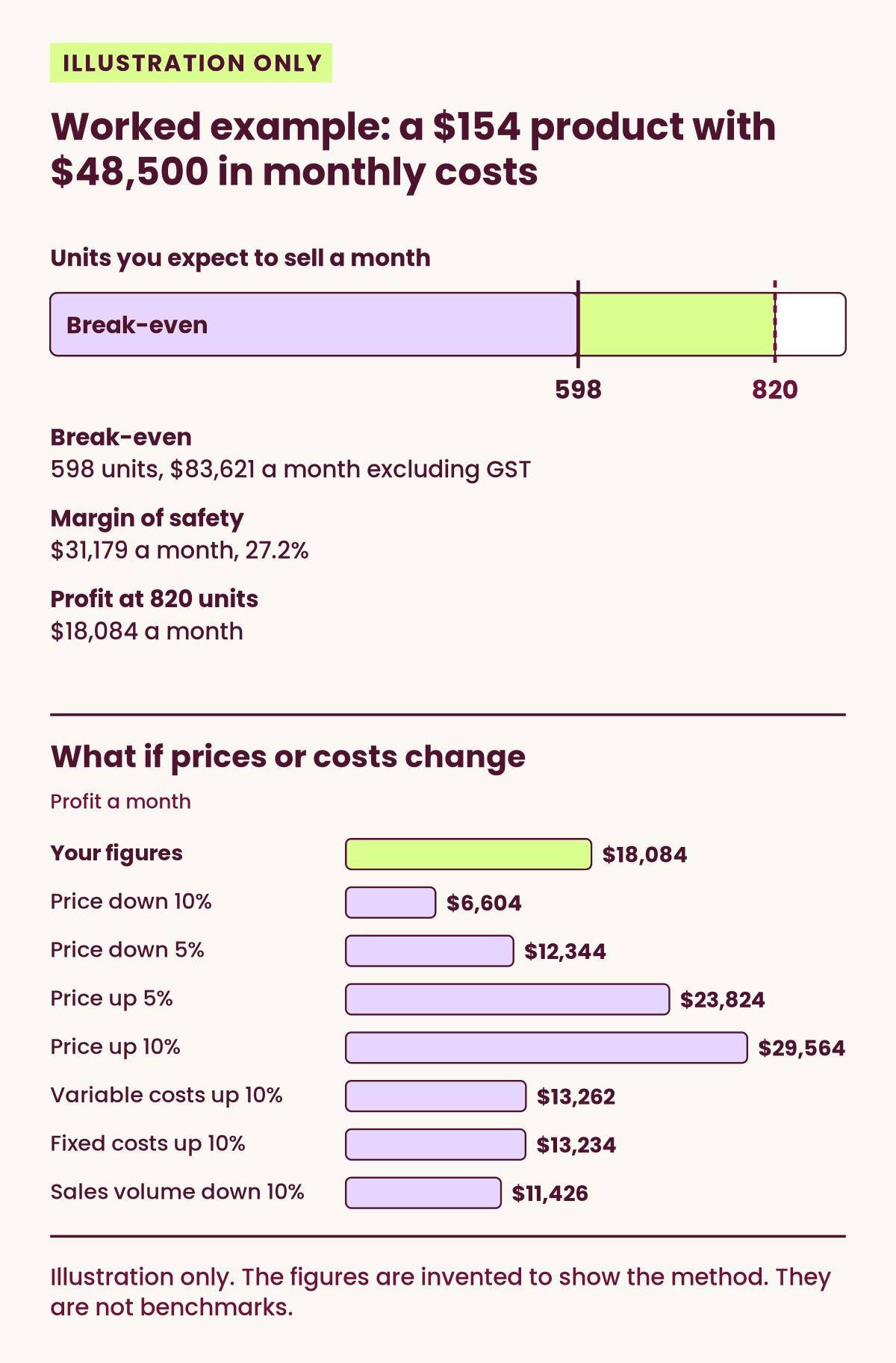
Worked example: a $154 product with $48,500 in monthly costs
Illustration only. The figures are invented to show the method. They are not benchmarks.
A GST-registered business sells a product for $154 including GST, or $140 excluding it. Each unit costs $58.80 in stock, packaging and fees. Rent, wages and other fixed costs come to $48,500 a month. It expects to sell 820 units a month and wants $12,000 a month in profit.
| Result | Value |
|---|---|
| Contribution per unit | $81.20, or 58.0% of the price |
| Break-even | 598 units, $83,621 a month excluding GST |
| Break-even including GST | $91,983 a month |
| Margin of safety | $31,179 a month, 27.2% |
| Profit at 820 units | $18,084 a month |
| Sales for $12,000 profit | 746 units, $104,310 excluding GST |
What if prices or costs change
| Scenario | Break-even units | Break-even sales ex GST | Profit a month |
|---|---|---|---|
| Your figures | 598 | $83,621 | $18,084 |
| Price down 10% | 722 | $90,938 | $6,604 |
| Price down 5% | 654 | $86,934 | $12,344 |
| Price up 5% | 550 | $80,833 | $23,824 |
| Price up 10% | 510 | $78,456 | $29,564 |
| Variable costs up 10% | 644 | $90,149 | $13,262 |
| Fixed costs up 10% | 658 | $91,983 | $13,234 |
| Sales volume down 10% | 598 | $83,621 | $11,426 |
- A 10% price cut removes 63% of the monthly profit. A 10% drop in volume removes 37%.
- A 5% price rise adds $5,740 a month, more than a 10% cut in fixed costs would.
Break-even questions
How do I calculate my break-even point?
Take the selling price, subtract the variable cost per unit, and divide your fixed costs by the result. That gives the units to sell. Divide fixed costs by the contribution margin, as a percentage of price, to get the sales in dollars.
Do I use prices with or without GST?
Without. GST you collect on sales goes to the ATO, and GST on business purchases is generally claimed back as a credit, so neither is income or cost. The calculator removes one-eleventh from a GST-inclusive price and also shows break-even sales including GST.
What counts as a fixed cost and a variable cost?
Fixed costs stay the same whatever you sell: rent, salaries, insurance, software and your own wage. Variable costs rise with each sale: stock, materials, packaging, freight, card fees and commissions. Split costs that are partly both.
What is a margin of safety?
The gap between expected sales and break-even sales, shown in dollars and as a percentage of expected sales. It shows how far sales can fall before the business makes a loss.
How much do I need to sell to make a set profit?
Add the profit you want to your fixed costs, then divide by the contribution per unit for units, or by the contribution margin for sales. The calculator shows both, excluding and including GST.
Does the calculator keep my figures?
No. Your figures stay in your browser. They reach Acctivate only if you ask us to look over them.
Pricing and profit with Acctivate
Acctivate works with business owners around Australia from Fortitude Valley, Brisbane, on business accounting and advisory, tax planning and compliance, and Xero and systems set-up. Chartered Accountants Elle Green and Simon Burke lead the work.
business accounting and advisory
General information only, not financial, tax or legal advice. Results depend on the figures entered and assume fixed costs and the cost per unit don't change with volume.
ACCTIVATE PTY LTD · ABN 63 677 493 882 · Level 5/ 269 Wickham St, Fortitude Valley · (07) 3185 5303
