
HIRING CALCULATOR
Employee Affordability Calculator
Work out what one new employee costs once super, leave, payroll tax, workers’ comp, equipment and recruitment are in, then see the sales the business needs to carry them and the month the hire pays for itself.
- Full cost in year one and every year after
- Sales and gross profit needed to cover the hire
- Payback month and the cash needed until then
For Australian employers in every state and territory. Results show as you type. No sign-up.
From Acctivate Business Accountants, led by Chartered Accountants Elle Green and Simon Burke. Registered Tax Agent.
Employee cost calculator: enter the role
Enter yearly figures excluding GST. Results update as you type.
Your results
Add a yearly salary to see the full cost.
Leave and holidays can't add up to a full year.
Total cost in year one
–
Then – a year (– a month).
Pays for itself in month .
Doesn't cover its cost at these figures. At full productivity it's a month short.
Pays for itself after month 36 at these figures.
Add expected extra sales to see when the hire pays for itself.
Cash needed before the hire pays its way
– at month
The lowest point of the running position, including one-off costs.
Sales needed to carry the hire
– a month · – a year
At your gross profit margin. Gross profit needed: – a year.
On-costs above salary
–
Cost per productive hour
– over – hours
After annual leave, personal leave and public holidays.
Payroll tax check
With this hire, yearly wages of stay underpass the threshold of . Payroll tax may apply: enter your rate above. Your rate of % is included.
Leave built up in a year
Annual leave–
Personal leave–
Already inside the salary. Paid when the leave is taken.
Not included: award penalty rates and overtime, casual loading, long service leave, fringe benefits tax, payroll tax deductions that phase out, and wage subsidies.
Running position by month
Gross profit from the hire less its costs, added up month by month. Bars below the line are months the business is still funding the hire.
Cost breakdown
| Salary | – |
|---|---|
| Super | – |
| Leave loading | – |
| Payroll tax | – |
| Workers' compensation | – |
| Other yearly costs | – |
| Cost each year | – |
| Equipment and set-up | – |
| Recruitment | – |
| Year one total | – |
Month by month
| Month | Productivity | Cost | Gross profit | Running position |
|---|
Discuss your figures
Your results are above. Want an accountant to look over the hire with you? It’s optional.
We use your details only to respond. Nothing is stored unless you send it. Privacy policy
How to read the results
Cost each year and year one
Cost each year is salary plus super, leave loading, payroll tax, workers’ comp and other yearly costs. Year one adds equipment and recruitment.
Sales needed to carry the hire
The gross profit has to match the yearly cost. Divide that by your margin and you have the extra sales needed, before any profit from the role.
Payback and cash needed
Each month the hire’s gross profit, scaled by productivity, is set against its cost. Payback is the first month the running total reaches zero. Cash needed is the deepest point before that.
Cost per productive hour
Leave and public holidays are paid but not worked. Dividing the yearly cost by hours actually worked gives the real hourly cost of the role.
Super is worked out on salary as qualifying earnings. Payroll tax and workers' comp use salary, leave loading and super as the wage base. Yearly costs are spread evenly across 12 months; one-off costs fall in month 1.
Where each figure comes from
| Figure | What it means | Where to find it |
|---|---|---|
| Salary or wages | Yearly pay before tax, without super | Award pay guide, job ad, offer letter |
| Leave loading | Extra pay on annual leave, if the award or agreement sets it | The award or enterprise agreement |
| Payroll tax rate | Your state’s rate on wages above the threshold | State revenue office, or your current payroll tax return |
| Workers’ comp premium | Your insurer’s rate for this kind of work | Workers’ compensation policy or renewal notice |
| Gross profit margin | Sales less direct costs, as a share of sales | Profit and loss report |
| Extra sales | Sales this role will win or handle | Sales pipeline, capacity you turn away today |
Payroll tax thresholds by state, 2026–27
Payroll tax applies only when total Australian wages, including any group of businesses, pass the threshold. The rate applies to wages above it.
| State or territory | Yearly threshold | General rate |
|---|---|---|
| Australian Capital Territory | $1.75 million | 6.75% up to $20 million in wages; higher above |
| New South Wales | $1.2 million | 5.45% |
| Northern Territory | $2.5 million | 5.5%; 6.5% at $100 million or more |
| Queensland | $1.3 million | 4.75% up to $6.5 million in wages; 4.95% above |
| South Australia | $1.5 million | Phased in from $1.5 million to $1.7 million; 4.95% above |
| Tasmania | $1.25 million | 4% up to $2 million; 6.1% above |
| Victoria | $1 million | 4.85%; 1.2125% for regional employers |
| Western Australia | $1 million | 5.5% |
General information from the state and territory revenue offices. Thresholds can be lower if you employ for part of the year or in more than one state, and in some states they shrink as wages rise.
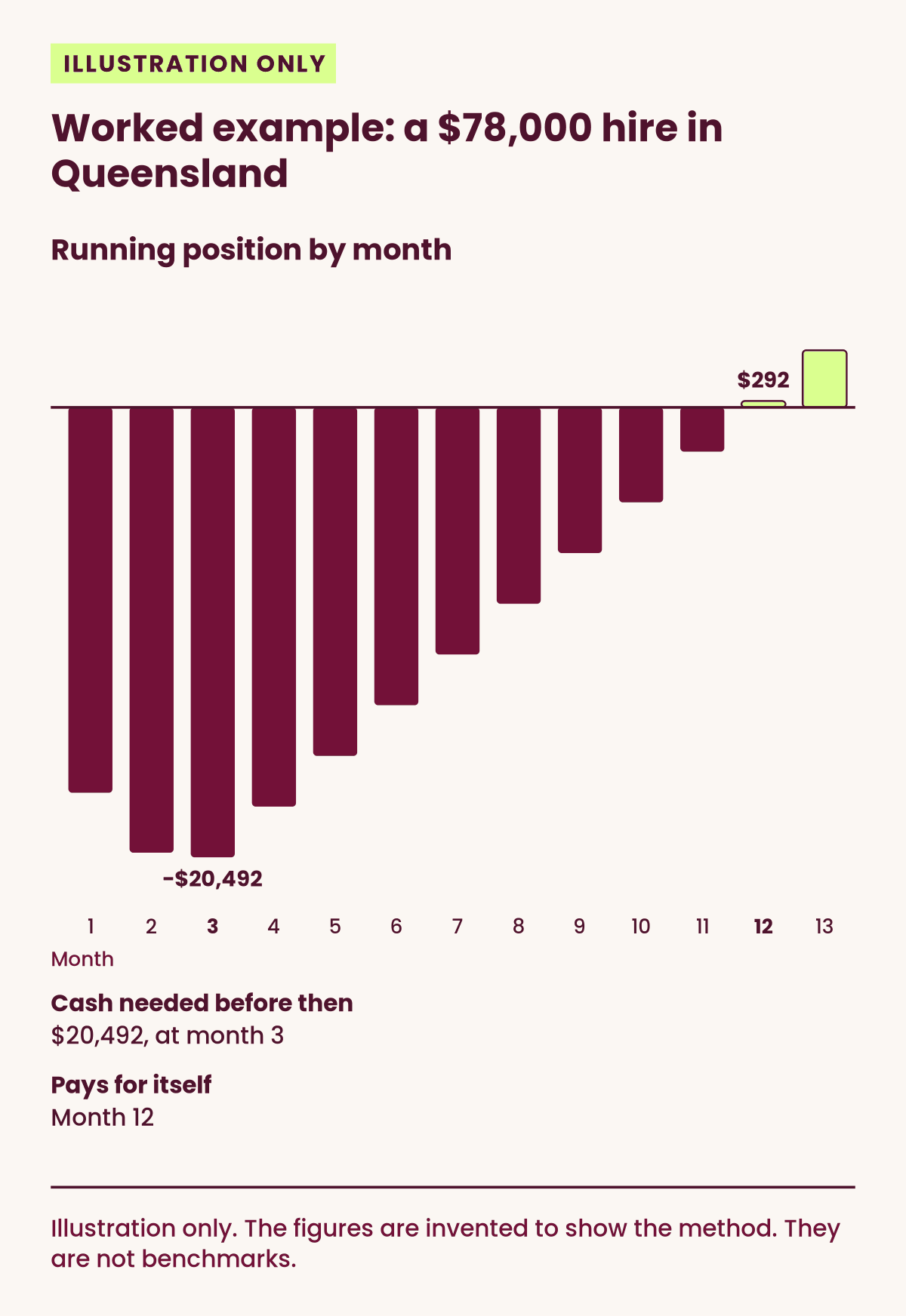
Worked example: a $78,000 hire in Queensland
Illustration only. The figures are invented to show the method. They are not benchmarks.
A Queensland business with $640,000 in wages plans a $78,000 role on 38 hours, with a 17.5% leave loading under its award and a 1.4% workers’ comp premium. Software and phone add $3,600 a year, a laptop and desk $4,500, and recruitment $7,800. The business earns a 42% gross margin and expects the role to bring in $24,000 a month once settled, starting at 25% in month 1 and reaching full speed after 3 months.
| Result | Value |
|---|---|
| Cost each year | $93,248 ($7,771 a month) |
| Year one total | $105,548 |
| On-costs above salary | 19.55% |
| Cost per productive hour | $55.77 over 1,672 hours |
| Sales needed to carry the hire | $18,502 a month |
| Pays for itself | Month 12 |
| Cash needed before then | $20,492, at month 3 |
| Payroll tax | None: wages of $728,410 stay under the $1.3 million threshold |
Where the $93,248 goes
| Cost | Amount | Share of salary |
|---|---|---|
| Salary | $78,000 | 100% |
| Super at 12% | $9,360 | 12.0% |
| Leave loading | $1,050 | 1.35% |
| Workers’ compensation | $1,238 | 1.59% |
| Other yearly costs | $3,600 | 4.62% |
- The role covers its monthly cost from month 4, yet the business carries $20,492 before the running total turns positive.
- The same hire in a business with $1.25 million in wages would pass the Queensland threshold and attract payroll tax.
Cost of hiring questions
What does an employee cost on top of salary?
Super at 12%, leave loading if the award or agreement includes it, workers’ compensation insurance, payroll tax once total wages pass your state’s threshold, plus equipment, recruitment and running costs such as software and phones. Workers’ comp must come from an authorised insurer.
Is super still 12% in 2026–27?
Yes. Super guarantee is 12% of qualifying earnings for 2026–27 and later years. Under Payday Super it’s due with each pay, and the fund must receive it within 7 business days. It isn’t required on earnings above $270,830 a year.
Do I pay payroll tax on a new hire?
Only if total Australian wages, including any group businesses, pass your state or territory threshold. Thresholds for 2026–27 run from $1 million in Victoria and Western Australia to $2.5 million in the Northern Territory, and the rate applies to wages above the threshold.
Do I have to pay leave loading?
Not always. Leave loading applies only where the award or enterprise agreement says so. Some awards set a 17.5% loading, and some compare it with the weekend or shift penalties the employee would have earned and pay the higher amount.
How long before a new employee pays for themselves?
It depends on the margin on the work they bring in and how fast they get up to speed. The calculator adds up gross profit less cost month by month and shows the first month the total reaches zero, plus the cash needed until then.
Does the calculator keep my figures?
No. Your figures stay in your browser. They reach Acctivate only if you ask us to look over them.
Planning a hire with Acctivate
Acctivate works with business owners around Australia from Fortitude Valley, Brisbane, on business accounting and advisory, tax planning and compliance, and Xero and systems set-up. Chartered Accountants Elle Green and Simon Burke lead the work.
business accounting and advisory
General information only, not financial, tax, legal or employment advice. Results depend on the figures entered. Pay rates, leave and loadings come from the relevant award, agreement or the National Employment Standards, and payroll tax from your state revenue office.
ACCTIVATE PTY LTD · ABN 63 677 493 882 · Level 5/ 269 Wickham St, Fortitude Valley · (07) 3185 5303
