
UNIT COST CALCULATOR
Manufacturing Unit Cost Calculator
Find what one good unit really costs to make once materials, labour time, factory overheads, setup and scrap are counted. Then see your margin at today’s price, the price that hits your target, and the volume you need to break even.
- Cost per good unit, part by part
- Margin, markup and the price for your target margin
- Break-even volume, batch size effects and unrecovered overheads
For Australian manufacturers and producers making in batches. Results show as you type. No sign-up.
From Acctivate Business Accountants, led by Chartered Accountants Elle Green and Simon Burke. Registered Tax Agent.
Unit cost calculator: enter your figures
Enter one product and one batch, excluding GST. Results update as you type.
Your unit cost
Add a batch size and materials cost to see your unit cost.
Cost per good unit
–
Cost per good unit by part
- Materials–
- Labour–
- Setup–
- Overheads–
- Of which scrap adds–
Overhead rate
–
Production overheads divided by machine hours.
At your price
- Margin–
- Margin %–
- Markup %–
- Price including GST–
Price for your target margin
- Excluding GST–
- Including GST–
Break-even volume
–
Good units a year to cover all fixed costs.
At your planned volume
- Overheads recovered–
- Actual overheads–
- Under- or over-absorbed–
- Profit a year–
Not included: GST timing, stock held over, rework, price discounts, and costs shared across several products.
Batch size
| Batch size | Good units | Cost per good unit | Setup per unit | Margin at your price |
|---|---|---|---|---|
| – | – | – | – | – |
| – | – | – | – | – |
| – | – | – | – | – |
| – | – | – | – | – |
| – | – | – | – | – |
Same figures, different batch sizes. Your batch is in bold.
Discuss your figures
Your results are above. Want an accountant to look over your costing with you? It’s optional.
We use your details only to respond. Nothing is stored unless you send it. Privacy policy
How the unit cost is built
Materials and labour
Every unit started uses materials and labour, including the ones that end up as scrap. Labour is minutes per unit times the hourly cost.
Overhead absorption rate
Production overheads for the year divided by the machine hours you expect to run. Each unit picks up its share through the machine minutes it uses.
Setup and scrap
Setup is paid once per batch, so bigger batches spread it thinner. Scrap shares the whole batch cost over fewer good units.
Under- and over-absorbed overheads
If you run fewer hours than planned, your unit cost recovers less overhead than you actually spend. That shortfall comes straight off profit. Running more hours does the reverse.
One product. All amounts exclude GST. Materials, labour and setup move with volume; production overheads and other fixed costs don't.
Where each figure comes from
| Figure | What it means | Where to find it |
|---|---|---|
| Materials per unit | Cost of everything that goes into one unit | Bill of materials, supplier invoices |
| Labour minutes and rate | Hands-on time per unit, and its full hourly cost | Job timesheets, payroll reports |
| Machine time and hours a year | Minutes per unit, and planned running hours | Machine counters, production schedule |
| Production overheads | Factory costs for the year | Profit and loss report, factory cost accounts |
| Scrap and setup | Lost units and changeover cost per batch | Production records, quality logs |
| Other fixed costs | Everything outside the factory | Profit and loss report |
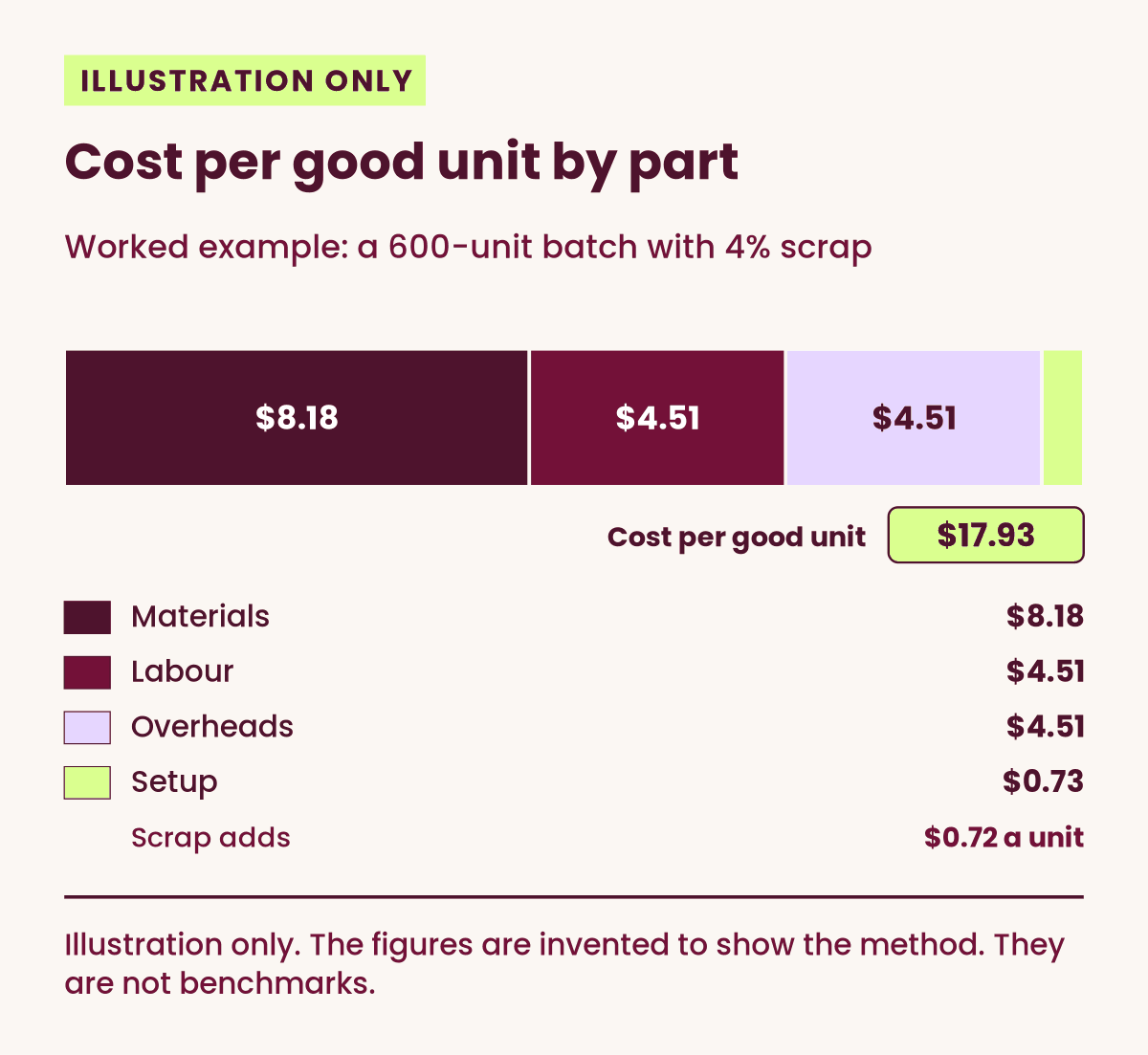
Worked example: a 600-unit batch with 4% scrap
Illustration only. The figures are invented to show the method. They are not benchmarks.
A maker starts batches of 600 units, loses 4% to scrap and pays $420 to set up each batch. Each unit uses $7.85 of materials, 5 minutes of labour at $52 an hour and 4 machine minutes. Production overheads are $468,000 a year over 7,200 machine hours. It sells at $29.50 excluding GST, wants a 40% margin, has $590,000 of other fixed costs and plans to sell 90,000 units a year.
| Result | Value |
|---|---|
| Good units per batch | 576 (24 scrapped) |
| Batch cost | $10,330 |
| Overhead rate | $65.00 per machine hour |
| Cost per good unit | $17.93 |
| Materials · labour · overheads · setup | $8.18 · $4.51 · $4.51 · $0.73 |
| Scrap adds | $0.72 a unit |
| Margin at $29.50 | $11.57 a unit, 39.2% |
| Price for a 40% margin | $29.89 excluding GST |
| Break-even volume | 65,797 good units a year |
| Overheads under-absorbed at 90,000 units | $61,750 |
| Profit a year | $389,188 |
| Batch size | Cost per good unit | Setup per unit | Margin at $29.50 |
|---|---|---|---|
| 150 | $20.12 | $2.92 | 31.8% |
| 300 | $18.66 | $1.46 | 36.7% |
| 600 | $17.93 | $0.73 | 39.2% |
| 1,200 | $17.57 | $0.36 | 40.4% |
| 2,400 | $17.39 | $0.18 | 41.1% |
- 90,000 units use 6,250 machine hours, not the 7,200 the rate assumes, so $61,750 of overhead isn’t recovered.
- Doubling the batch to 1,200 cuts $0.36 a unit and lifts the margin above 40%.
Unit cost questions
How do I work out the cost per unit of a product?
Add up a batch’s materials, labour, setup and share of production overheads, then divide by the good units it produces. Dividing by good units rather than units started puts the cost of scrap into the price of what you sell.
What is an overhead absorption rate?
Production overheads for the year divided by a measure of activity, usually machine hours or labour hours. Each unit picks up overheads at that rate for the time it uses.
What does under-absorbed overhead mean?
Your rate assumed more hours than you ran, so your unit costs recovered less than the overheads you actually paid. The gap reduces profit even though every unit looked profitable.
How do scrap and batch size change unit cost?
Scrap spreads the whole batch cost over fewer good units. Setup is a fixed cost per batch, so small batches carry more of it per unit.
How does the ATO value manufactured stock?
The ATO’s view is that manufactured stock on hand at year end valued at cost uses absorption cost: materials, direct labour and a share of production overheads. Selling, marketing, finance and general office costs, and costs from scrap, spoilage and rework, are left out. You can also value stock at market selling value or replacement value. This calculator’s unit cost is for pricing, so it includes scrap.
Does the calculator keep my figures?
No. Your figures stay in your browser. They reach Acctivate only if you ask us to look over them.
Costing and pricing with Acctivate
Acctivate works with business owners around Australia from Fortitude Valley, Brisbane, on business accounting and advisory, tax planning and compliance, and Xero and systems set-up. Chartered Accountants Elle Green and Simon Burke lead the work.
business accounting and advisory
General information only, not financial, tax or legal advice. Results depend on the figures entered and are a management cost for pricing, not a stock valuation for tax.
ACCTIVATE PTY LTD · ABN 63 677 493 882 · Level 5/ 269 Wickham St, Fortitude Valley · (07) 3185 5303
