
WORKING CAPITAL CALCULATOR
Stock and Working Capital Calculator
See how many days your cash sits in stock and unpaid invoices, how much working capital that ties up, what next year’s growth will need, and what faster collections, leaner stock or longer supplier terms would free.
- Stock, debtor and creditor days, and your cash conversion cycle
- Extra cash growth needs, and the funding gap
- The dollar value of one day on each lever
For Australian businesses that hold stock or sell on credit. Results show as you type. No sign-up.
From Acctivate Business Accountants, led by Chartered Accountants Elle Green and Simon Burke. Registered Tax Agent.
Working capital calculator: enter your figures
Use yearly sales and costs, and balances from your latest balance sheet. Results update as you type.
Your working capital
Add your sales, cost of sales and the three balances to see your cycle.
Cash conversion cycle
–
Working capital tied up now
–
Stock plus debtors less creditors, excluding GST.
- Debtors–
- Creditors–
Next year
- Growth needs–
- New terms release–
- Extra cash needed–
- Set aside–
- Funding gap–
Balances next year at your targets
- Stock–
- Debtors–
- Creditors–
Not included: seasonal swings, GST and BAS timing, other current assets and liabilities, and finance costs.
Days by lever
| Lever | Now | Target | Cash effect next year | One day is worth |
|---|---|---|---|---|
| Stock days | – | – | – | – |
| Debtor days | – | – | – | – |
| Creditor days | – | – | – | – |
| Cash conversion cycle | – | – | – | – |
A minus figure is cash released. Creditor days work the other way: more days release cash.
Discuss your figures
Your results are above. Want an accountant to look over your working capital with you? It’s optional.
We use your details only to respond. Nothing is stored unless you send it. Privacy policy
How to read your working capital
Stock, debtor and creditor days
Stock days is how long stock sits before it sells. Debtor days is how long customers take to pay. Creditor days is how long you take to pay suppliers.
Cash conversion cycle
Stock days plus debtor days, less creditor days. It’s how long each dollar spent on stock is out of the bank before a customer’s payment brings it back.
What growth needs
More sales on the same terms mean more stock and more unpaid invoices. That extra working capital has to be funded before the profit from the growth arrives.
Funding gap
The extra cash next year needs, after the effect of your target days and the cash or finance you’ve set aside.
Days use a 365-day year. Creditor days use cost of sales as a stand-in for purchases. Balances that include GST are reduced by one-eleventh, treating every sale and purchase as taxable.
Where each figure comes from
| Figure | What it means | Where to find it |
|---|---|---|
| Yearly sales and cost of sales | Last 12 months, or the coming year’s budget, excluding GST | Profit and loss report |
| Stock on hand | Stock at cost | Balance sheet, or your year-end stocktake |
| Money customers owe you | Unpaid sales invoices | Aged receivables report |
| Money you owe suppliers | Unpaid supplier bills | Aged payables report |
| Target days | The terms you plan to work to | Payment terms on invoices, supplier agreements, reorder levels |
A business with a big season can average its opening and closing balances to smooth the figures.
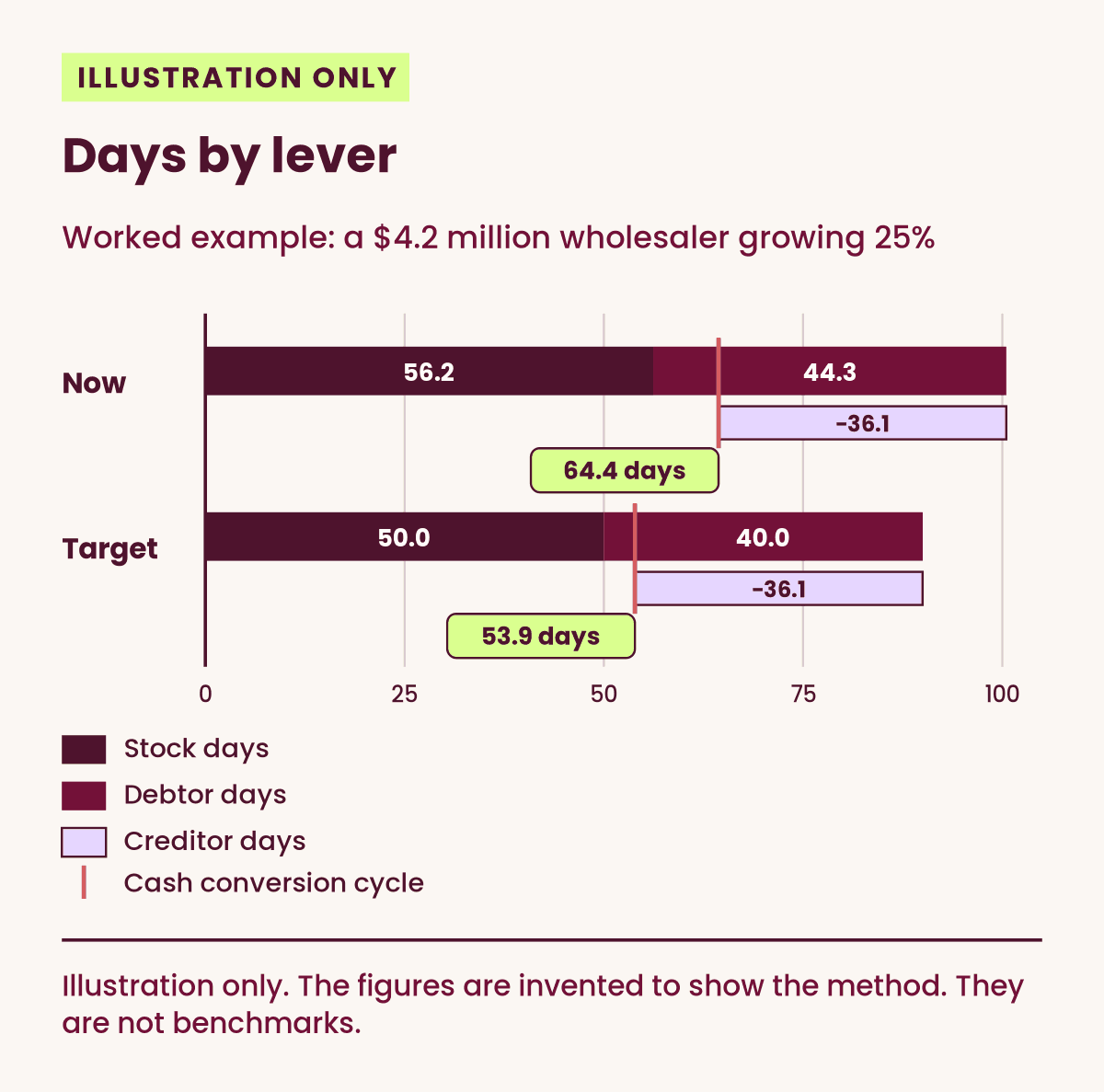
Worked example: a $4.2 million wholesaler growing 25%
Illustration only. The figures are invented to show the method. They are not benchmarks.
A wholesaler sells $4.2 million a year excluding GST, with $2.73 million in cost of sales. Its balance sheet shows $420,000 of stock, $561,000 owed by customers and $297,000 owed to suppliers, both including GST. It expects 25% growth, plans to cut stock to 50 days and debtors to 40 days, and has $30,000 set aside.
| Lever | Now | Target | Cash effect next year | One day is worth |
|---|---|---|---|---|
| Stock days | 56.2 | 50.0 | −$57,534 | $9,349 |
| Debtor days | 44.3 | 40.0 | −$62,158 | $14,384 |
| Creditor days | 36.1 | 36.1 | $0 | $9,349 |
| Cash conversion cycle | 64.4 days | 53.9 days |
| Result | Value |
|---|---|
| Working capital tied up now | $660,000 |
| Growth needs | $165,000 |
| New terms release | $119,692 |
| Extra cash needed | $45,308 |
| Set aside | $30,000 |
| Funding gap | $15,308 |
- On today’s terms, 25% growth would tie up another $165,000.
- Each day customers pay sooner is worth $14,384 next year, more than a day of stock or supplier credit.
Working capital questions
What is the cash conversion cycle?
The number of days between paying for stock and getting paid by the customer. It’s stock days plus debtor days, less creditor days. Longer supplier terms shorten it; slow-moving stock and slow payers lengthen it.
How do I work out stock, debtor and creditor days?
Stock days is stock divided by yearly cost of sales, times 365. Debtor days is what customers owe divided by yearly sales, times 365. Creditor days is what you owe suppliers divided by yearly cost of sales, times 365. Use figures excluding GST.
Why does a growing business run short of cash?
Stock is bought and staff are paid before customers settle their invoices. More sales on the same terms lock up more cash in stock and debtors, so a profitable business can still need extra funding while it grows.
Why take GST out of debtors and creditors?
Sales and cost of sales are measured excluding GST, while invoices usually include it. Taking one-eleventh out of each balance keeps the days on the same basis as the sales and costs.
Can the cash conversion cycle be negative?
Yes. If customers pay before suppliers are due, suppliers fund the stock and the cycle drops below zero. Growth then releases cash instead of using it.
Does the calculator keep my figures?
No. Your figures stay in your browser. They reach Acctivate only if you ask us to look over them.
Cash and working capital with Acctivate
Acctivate works with business owners around Australia from Fortitude Valley, Brisbane, on business accounting and advisory, tax planning and compliance, and Xero and systems set-up. Chartered Accountants Elle Green and Simon Burke lead the work.
business accounting and advisory
General information only, not financial, tax or legal advice. Results depend on the figures entered and use yearly averages, so a seasonal business can need more at its peak.
ACCTIVATE PTY LTD · ABN 63 677 493 882 · Level 5/ 269 Wickham St, Fortitude Valley · (07) 3185 5303
